Beginnings of A Continental Navy

This week in Revolutionary War History, let’s discuss what was going on 250 years ago in and around the colonial Province of Massachusetts Bay. Last week, supply issues still plagued the Continental Army with no real end in sight, all while an offensive campaign north into Quebec began and King George III signed the “Proclamation of Rebellion,” officially signaling the British Empire is in an active state of war.

            On August 27, 1775, Major General Philip Schuyler writes to Washington from Albany, New York, different from his usual post at Fort Ticonderoga. Schuyler states he was in the area and had an impromptu meeting with the Six Nations of the Iroquois Confederacy, or the Haudenosaunee. At one point, this confederacy of different tribes encompassed a colossal landmass, from what would become Montreal, down the Saint Lawrence to Ohio and south to areas of Kentucky and Virginia. At the time of the meeting, they are further being driven into present day Upstate New York. The general tells Washington that the committee he met with was open and accepting to their neutrality in the conflict but had no interest in their own involvement on the American side. Schuyler writes, “they explicitly declared that as it was a family quarrel, they would not interfere, but remain [neutral] and hoped we would not desire more of them.”

            Unfortunately, this agreement was not to last. With hindsight, we know the confederation would suffer its first major splinter with some tribes supporting the British, and others the Americans. This would primarily be due to a lack of trade and immense pressure from both sides. The conflict would spell the doom of the Haudenosaunee, a peaceful network and confederation of tribes and peoples that had lasted roughly half a millennium.

            For now, the tribes are neutral. On August 29 in his General Orders, Washington reminds his men to adhere to his previously implemented food (bread) standards, as “complaints are continually making of the badness of the bread.” The same day, he writes to the Massachusetts Council, primarily working out of Cambridge, Concord, or Watertown due to Boston’s continued occupation, pushing for price controls on exorbitant fees for firewood, oats, and hay. He feels he is being extorted due to the army’s need. He writes, “I have great Reason to believe that this is an artificial scarcity partly created by some persons who are monopolizing those articles in order to advance the price.” Should prices not come down, Washington warns “the great Law of Self Preservation must authorize us to compel them.” Basically, coercion or forced acquisition.

            The following day, Washington’s General Orders are to mobilize about 600 men from two different brigades and march to the recently recaptured “Plough’d Hill” just outside Boston, present day Mount Benedict in Somerville. Surgeons and medics, he mentions, must also follow suit. Action is predicted as the army holding the hill is underequipped and being assaulted from the British.

            On August 31, Washington addresses confusion over pay, and a lack of pay, in his General Orders. Some regiments pay by lunar month and others by calendar month. Washington commands all regiments of Massachusetts Forces to pay their men immediately, at the same time, by calendar month. The same day, Washington is made aware that Messr Clarke & Nightingale of Providence have imported a substantial quantity of gunpowder, lead, and arms. He dispatches his Aide-de-Camp, Captain George Baylor, to strike a deal and acquire this material. He tells them to send the material and the bill, and whatever is asked will be “honored on the shortest notice.”

            On September 1, Philip Schuyler is joining up with General Montgomery in Quebec at Isle-au-noix. He is under the belief that both natives and Canadians will be friendly with the Continental Army, eventually helping them in driving out British forces. The same day, Washington hears from Lieutenant Colonel Loammi Baldwin in Chelsea that the Select Men (the Tri-Town still carrying on a long history of local governance) of the town have stated their worry and opposition to the 80-or-so men stationed in the town. He states the town is “vastly destressed and impoverished by repeated difficulties” and barracks should be built with great haste.

            Finally on September 2, Washington lays the groundwork for the Continental Navy, assigning Nicholson Broughton as Captain of recently acquired 4-gun schooner Hannah, eventually to have the name USS Hannah awarded after its service.

This Week in Revolutionary History…

By Sam Bishop

Work Remains on MS4 Bylaw

On Tuesday, September 2, the Marion Planning Board met and held a public hearing on the proposed addition of a new section to the Zoning Bylaw to address Municipal Separate Storm Sewer (MS4) General Permits to the Code of the Town of Marion.

            Per the Marion Department of Public Works, “In compliance with the Clean Water Act (CWA), the General Permit for Stormwater Discharges from Small Municipal Separate Storm Sewer Systems (MS4) authorizes any operator of a small municipal separate storm sewer system to discharge stormwater runoff under the National Pollutant Discharge Elimination System (NPDES), in accordance with the conditions and requirements set forth under the MS4 General Permit.” In order to maintain compliance with state laws, the town is late and must pass MS4 guidelines soon or face state-imposed penalties.

            Before talks on the MS4 Bylaw itself, Jennifer Francis and Kerry Saltonstall of the Marion Transportation & Circulation Task Force spoke first and focused on Route 6. They stated in their presentation that the road through town has “poor pavement condition and drainage issues.” The panel said the road has not been paved since 1987, or about 40 years. They also mentioned the route basically bisects the town, blocking those on the north side from easy foot/bike access to Town Center and beaches. They presented various plans for the redevelopment of Route 6, with Francis saying, “making the whole area much safer and getting rid of the divide between north and south Marion” and added “nothing is set in stone. There is still a long way to go.”

            Widening the road will not be necessary or sought. As future development in both housing and business is planned for the area in town and connecting to Route 6 directly, they recommended improving the road as soon as possible. “The question was, how do we make the town more pedestrian-friendly?” Saltonstall said. They emphasized this being a work in progress with nothing truly finalized.

            Following talks on Route 6, the public hearing on MS4 thus began. Chair Andrew Daniel stated first the bylaw is very much “ever changing” and a work in progress. Vice Chair Alanna Nelson stated the bylaw should be easy to pass through, though there is the prevalent worry by the board that, should this be a zoning bylaw (as recommended by Nelson), it would require a two-thirds supermajority to pass. Nelson also said public hearings on the proposed bylaw “should be often” as it is “hard to do that [kind of talk] at Town Meeting.”

            Upon being questioned by a member of the audience, the board agreed that the MS4 Bylaw draft should be available online for download on the town website (marionma.gov). Member Tucker Burr said, “I think too many people [will] see it the first time at Town Meeting.”

            The public hearing didn’t contain many comments from the public, and instead there was a discussion by the board on the current draft and areas of focus for change. When asked whether to close or continue the hearing, Town Planner Doug Guey-Lee cautioned against closing. “We have to be really mindful of that,” he said, referring to the day following the proposed continuance being when the Select Board is meeting to confirm the Fall Town Meeting schedule. Daniel believed work had to be done to the Rules and Regulation section. Therefore, the public hearing was tabled with a unanimous vote, with the stated section to be reworked.

            The next meeting of the Marion Planning Board will be held on Monday, September 15 at 7:00 pm in the Marion Police Station, 550 Mill Street or remotely accessible through Microsoft Teams.

Marion Planning Board

By Sam Bishop

What’s the story on Covid shots?

There was a surge in Covid infections this summer, and most predictions are for another in the coming winter. We are also facing flu and RSV outbreaks as surely as the sun rises.

            The best defense against respiratory viruses is immunization.

            While nothing is guaranteed 100% safe, vaccines offer the best combination of effectiveness and safety of any medical procedure offered.

            Upsetting all our plans for combatting the viruses is the chaos sown by RFK Jr, our conspiracy-theorist Secretary of HHS.

            Unless you have decided to ignore all available news media, you must be aware that Kennedy summarily fired the entire expert committee that was meant to advise Americans on which immunizations to receive and more recently arranged to fire the head of the CDC (Communicable Disease Center) because she refused to endorse his unsupported anti-vax ideas.

            While Kennedy has zero medical or scientific training on which to base his opinions, he has made millions of dollars in recent years peddling his conspiracy theories, both as salary from the Children’s Health Defense group he founded and from generous “referral fees” paid to him by law firms when he sent plaintiffs to them claiming injury from vaccines.

            The upshot is that while in past years, Covid boosters were recommended for all, Kennedy’s hand-picked FDA staff recently approved them only for people over 65 or those with medical conditions that put them at high risk for severe outcomes from Covid.

            What does that mean in practical terms?

            If you are over 65, you can get the shot just as in past years: from your doctor, at a community clinic or at your local pharmacy.

            There is a long list of qualifying conditions that put you at high risk. Some are obvious, such as HIV, blood cancer, diabetes and immunodeficiency, which affect only a small number.

            However, the list includes many other less obvious conditions that are common: obesity, current or past smoking, physical inactivity and current or recent pregnancy.

            In many states, the chain pharmacies have dropped their “come on in, it is free” approach of prior years, fearing they will not be reimbursed under the new guidelines. If you fit one of the broad groups that I listed, you may have to get your shot at a medical office or ask your doctor’s office to send you a prescription outlining your eligibility to take to the pharmacy.

            It is worth the extra effort. While most of us by now have been vaccinated and/or been ill with Covid, you CAN catch it again (and again) as it mutates, and vaccination is the best way to ensure it is a nuisance rather than a serious illness.

            Edward Hoffer MD is Associate Professor of Medicine, part-time, at Harvard.

What Does The Doctor Say?

By Dr. Edward Hoffer

Rochester Historical Museum

On September 17 at 7:00 pm our monthly meeting will be held at the Rochester Historical Museum at 355 County Rd., Rochester. The speaker will be Bruce Bassett who went on a search for ancestors on Ancestor. Com which led him first to the Sons of the American Revolution and then to Rochester. This is our second meeting related to finding Rochester’s Revolutionary veterans, either information about them or hopefully, their gravesites. Packets, containing lists of names, websites, and possible cemeteries, will be available at the meeting. Bruce may be able to answer questions on how to search after his talk.

            We are still looking for tools from Rochester’s past to be loaned or donated for our exhibit. You can bring them to the meeting or get in touch with me at eshbach2@aol.com or call 617-750-2818 or 508-763-4932.

The Will of the People

On a recent sunny Wednesday morning, the members of the Town Coffee Committee, charged with solving all the world’s problems, gathered at the town wharf. The meeting was called to order citing all members present (save one who absconded across the pond to the UK); a quorum was declared.

            First order of business (again) was a discussion of the five-member Select Board matter which has been discussed ad nauseum before the Committee. It was announced that the matter whizzed though the State House and the Senate in record time. The Governor signed it into law on August 22, a mere three months since it was voted upon.

            It seems that a cage fight is brewing. Not the one the current occupant of the Peoples’ House plans for the south lawn of the White House on the Fourth of July 2026 to celebrate the America’ 250th Anniversary. No, the one about the origin, process and possible result of this change.

            Following the lead of famous Sergeant Joe Friday, the “just the facts” detective of the old TV show Dragnet, this intrepid reporter has decided to get the facts concerning this bruhaha. I promise, dear reader, to leave no stone unturned.

            The issue began when a group of citizens concerned about the efficiency of the current three-person configuration filed a petition to place an article on the Town Meeting warrant urging the change to five members. They suggested that an increase would offer more qualified people the opportunity to run and serve. Notwithstanding the fact that historically past elections have had numerous uncontested races, including the last one where there were 10, was of no concern. Darn facts.

            With the required 10 voter signatures acquired and certified by the Town Clerk, the question was moved to the Town Meeting floor where it was voted upon by voice vote and passed.

            The Select Board in their wisdom first decided to table the urgent matter (typically a death knell for an issue), prompting some proponents to suggest that the “will of the people” was being ignored. The Board promptly sent the result onto the State House for approval, thus washing their hands of the issue.

            In the meantime, a second petition circulated for a Special Town Meeting to rescind the first vote, leaving the Board at the current three members. That one collected 283 signatures, 83 more than required. Both petitions followed the law. A Special Town Meeting is now required at a cost to the town even though the issue is moot. The Special Town Meeting will be merely an opinion poll. That’s all. There you go. Those are the facts. Darn those facts.

            Hackles are still being raised. One side has suggested that the first article was not voted on correctly. The other side proclaims the second petition was a “misuse of the process” and a “taxpayer-funded stunt.”

            Whoa, wait a minute, a stunt? When did our little hamlet become the harbinger of the Washington-style circus? The Town Coffee Committee has a rule… no politics. No name calling allowed. Just the facts. The issue was tabled before coffee was spilled or breakfast sandwiches were thrown.

            The agenda for the next Town Coffee Committee meeting has yet to be decided and that’s a fact.

            Mattapoisett resident Dick Morgado is an artist and happily retired writer. His newspaper columns appeared for many years in daily newspapers around Boston.

Thoughts on…

By Dick Morgado

Survey of Ponds Approved

The Rochester Conservation Commission Tuesday continued its review of a Notice of Intent application to permit ecological restoration work at the former Stuart Cranberry Bog on Walnut Plain Road proposed by the Buzzards Bay Coalition.

            Coalition consultants Alex Patterson and Sara Quintal explained when the hearing began at the last meeting that the plan is to remove the existing berms, culverts and irrigation lines, re-grade the bog surface, fill ditches, and create recreational improvements. The 230-acre parcel became cranberry bogs in the 1930s and discontinued as bogs only a few years ago. The BBC will restore 64 acres of the parcel back into natural wetlands.

            On Tuesday, the commission asked Patterson and Quintal to hire someone to conduct a peer review of the site’s hydrological (water) issues. This conclusion came after Chair Christopher Gerrior reported the majority of residents who have contacted him have expressed this concern. The residents want to make sure will not be more flooding of their properties, he told them. “We need to see how the water moves there,” Gerrior said. “It’s a matter of how the restoration project will affect the neighbors. That will not adversely affect them. We want the hydrology of the whole setup.”

            As Walnut Plain Road abutters in the hearing room looked on, Patterson said this project will not create more flooding. “The site will soak up the water and the water will not leave,” he said. The commission instructed Patterson and Quintal to suggest what peer-review firm they prefer. The commission will hire that firm. The Coalition will pay the tab. The commission then continued the hearing to its next meeting.

            In other action, the commission also continued to its next meeting the Notice of Intent hearing for work within wetlands for a ground-mounted solar array in the area of 600 Snipatuit Road and the Notice of Intent hearing on the construction and installation of floating and ground-mounted solar arrays at 53 Dexter Lane, both upon the petitioners’ requests.

            Conservation Agent Merilee Kelly reported plans to address the problem with the invasive plant species milfoil growing within Snipatuit Pond, as well as the town’s other ponds, Snow’s, Leonard, and Hathaway. The options to eliminate the weeds are either herbicide treatments or a harvesting machine, she said. But a map survey of the pond should be the first step and should be done soon. Such a survey would cost the town $5,000. The commission approved spending for this plan, “and the town administrator will source funds,” Gerrior said.

            Kelly reported the solar projects on Snipatuit Road, Featherbed Road, and Braley Hill Road have begun construction. Gerrior said residents need to know that they will soon see a lot of tree cutting in those areas because of those projects and should be aware of that.

            The next Conservation Commission meeting will be held on Tuesday, September 16 at 7:00 pm at Town Hall, 1 Constitution Way.

Rochester Conservation Commission

By Michael J. DeCicco

Marion Republican Town Committee

The Marion Republican Town Committee will conduct its next monthly meeting on Monday, September 8 at 7:00 pm at the Marion Music Hall, 164 Front Street, Marion. The public and new members are welcome. We look forward to seeing you there.

Mattapoisett Yacht Club Results

MYC August Series Ends on a perfect night – August 27. The Wednesday Night PHRF racers faced light and shifty winds during the races which concluded with a fantastic rainbow and sunset as they returned to the harbor afterwards. Before prizes were awarded everybody enjoyed pizza and drinks under the MYC tent. A round of applause was given to the MYC race committee for their hard work throughout the year.

            It was a perfect night for Lindisfarne to, winning their fourth straight race in B Fleet, capturing the August Series. Coming in second tonight was Chickadee, Kinsail in third and Fir Na Tine in fourth.

In A fleet, Restless was again the winner followed by No Quarter Given and Cocnuts. Surprise didn’t race in tonight’s race however posted a great win in the Buzzards Regatta last week in the Cruising class. Congratulations to Charles Churchill and crew.

Final August Series results:

            A Fleet – 1st- Restless, 2nd- No Quarter Given, 3rd- Surprise, 4th- Coconuts

            B Fleet – 1st- Lindisfarne, 2nd- Kinsail, 3rd- Chickadee in a tie breaker over Fir Na Tine placing 4th.

            Tuesday Night Ensign races were cancelled due to heavy winds leaving the final August standings as they were the week before. Odyssey wins the tight battle over Black Ice by one point. Uncle Fester finishes third for August, Brass Monkey fourth, Brou Ha Ha fifth, Hamburglar sixth, and Recess seventh.

            Next week MYC hosts the Phoenix Cup on Wednesday night. Boats from the Ensign class and A and B fleet compete against each other in a one race winner take all. Race starts at 6:00 pm.

The last race of the season is the MYC Fall Round the Bay race on September 13.

Meditations on The Mediterranean Landscapes

            Third in a series exploring Europe’s diverse landscapes and gardens, from formal designs to wild, natural beauty…

            Labor Day is finished and with it most of the summer, but I’m still reveling in some of the lovely memories of two months ago.

            My last piece recalled the beauty of Paris and how a promenade can lead to joyful discoveries. This segment of the trip focuses on more up-close and personal highlights in locales we visited in the south of France and along Spain’s east coast from Catalonia in the north to southern Andalusia, all touching the Mediterranean Sea.

            Together with friends and family (as well as my daughter and son-in-law’s cat Victor), we took the train from Paris’s Gare de Lyon to Montpelier where we felt the surge in temperature immediately. Arriving at the wedding venue (in Agde, near Sete) we heard the deafening chorus made by billions of cicadas – and felt the unremitting sun. This area is rich with grape vineyards that produce a wine grape known as Piquepoul. It has both dark-skinned (Piquepoul noir) and light-skinned (Piquepoul blanc) versions; by the way, both permitted blending grapes for the production of Chateauneuf-du-Pape. The vineyards surrounding the wedding venue, a former winery, are juxtaposed against something like a Sonoran Desert scene with towering succulents amid flora that is suited to the semi-arid Mediterranean climate. Set against stone buildings, it came with a resident goat and dog that Victor the cat would befriend.

            After the days surrounding the wedding, we headed onward by car to Cadaques, just over the French border into Catalonia, Spain. The Costa Brava is the coastal region in northeastern Spain (that stretches some 45 miles north of the Catalan capital of Barcelona), a place of pristine beaches, celebrated cuisine, and ancient fertile vineyards. Here, we spent several splendid days footsteps from the sea and within easy walking distance to the town with its white-washed buildings and picturesque harbor dotted with boats and lined with open-air restaurants.

            The landscape here is striking if not surreal, with umbrella-shaped pine and olive trees framing the rocky coast with views of the Pyrenees Mountains and tiny coves that once served as hideouts for pirates. The area became a retreat for surrealist artist Salvador Dali. We visited his former home in Portlligat, once a collection of fishing huts that he and his wife transformed into their home, now a museum. It is captivating in its eccentricity, reflecting the Surrealist artist’s creative process. You truly get a sense that Dali is standing with you as you tour the maze of rooms; there is such a sense of him being alive through his art and his collections. The tour guide revealed that Dali boasted of being the first to see the sunrise every morning on the Iberian Peninsula, having installed a specially angled mirror for this purpose, viewable from his bed.

            The sun-dappled garden frames a long pool that serves to showcase Dali’s surreal art, including sculptures, Greek statues, a giant egg, a bright pink lip sofa surrounded by Pirelli tire signs, and the famous Michelin Bibendum, all of this is set against irregular white stucco walls and stone hard scape with olive trees, palms, grasses, and white and pink geraniums leading up to a delightful tented seating area, all part of Dali’s elaborate staging. He and his wife, Gala, were known for hosting lavish and eccentric parties here with famous rock stars, actors and artists such as Walt Disney and Andy Warhol (no surprise there). The gardens were designed for public life and contemplation, with unique architectural elements like hidden corridors and peep holes, and a tower.

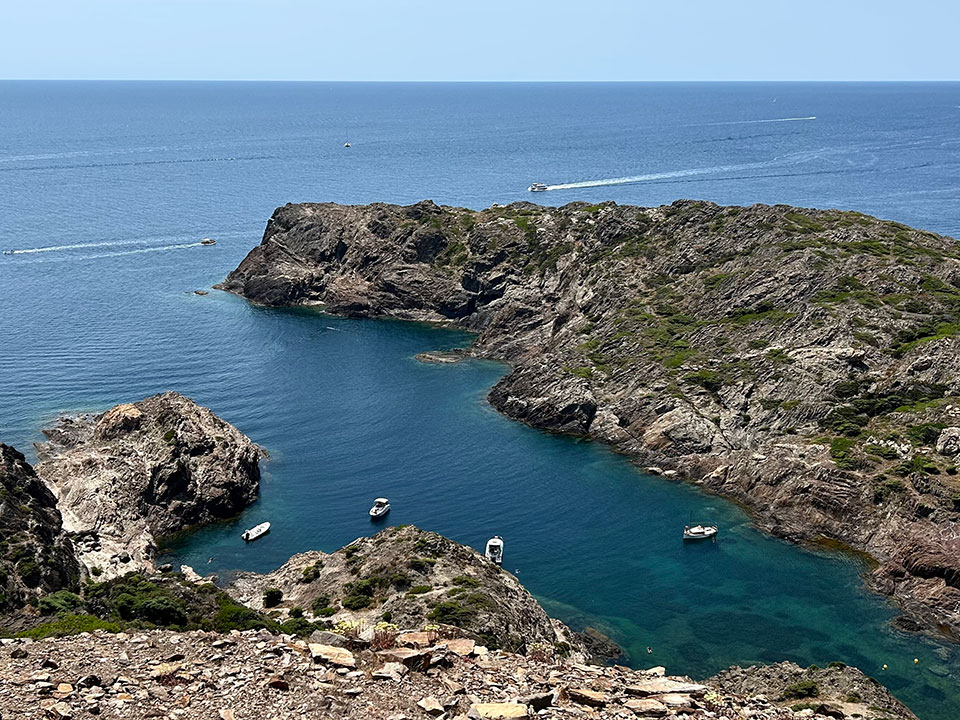
            Back to earth, a hike near this area, in the natural park of Cap de Creus, led to a commanding lighthouse built in 1853 serves as both a navigational light and a coastal reference point in one of the most challenging areas of the Catalan coast called Punta de l’Esquena. Cliffs plunge down to numerous watery inlets where boats seem antlike in perspective. It seems as untouched as the nature reserve above, with diminutive flowers juxtaposed against the majestic Pyrenees backdrop. The reserve is a sure destination for hikers and adventurers.

            Next stop was Barcelona but only for a night before a train took us south. Rather than searching out Gaudi’s architectural wonders (that will have to wait until some future time), we spent much of the day walking Las Ramblas, a famous tree-lined pedestrian boulevard that stretches past shops, restaurants, historic sites, and winds up at Port Vell. The energizing atmosphere is a huge draw for people, and you can expect street performers and artists, but be aware that pickpockets thrive here too. A bird’s eye view of Las Ramblas (once a riverbed) would show one long green strip of bisecting buildings, markets, and roads. To walk it is to appreciate the trees that cool the July heat. The garden atop our hotel extended this ambience, giving one pause to imagine how we could duplicate this idea back home.

            The trip south by train gave us a little rest before getting our rental car in Alicante and provided views of the east coast towns (well, what is viewable from the train). We rented a villa in the mountains near Bedar within reach of the sea as well as ancient fortresses built by the Moors and dating back to the 9th through the 14th centuries. Some days we would stay put whereupon I could “study” the structure of the gardens. In this hilltop community, the gardens are informal but still with a sense of design. Seemingly part of that “design” is the sound of house sparrows intermingled with Eurasian doves and a softer drone of cicadas but none of civilization.

            A multiple-species hedge that includes plumbago, two different colors of bougainvillea, hibiscus, sweet pea vine, and the ever-present pink oleander (which our host left a few sprigs of in little vases as a welcome gesture) grow against the interior wall surrounding the pool. Also, within the confines are palm, yucca, fig, bay, and lemon trees, along with a shrub-sized rosemary and scented geraniums and succulents that can withstand drought. As I studied these beauties, I wondered how my own plants were doing back home. The greenery is interspersed with terra-cotta pottery with functional or decorative features.

            Many villas in the region boast exquisite formal gardens. Symmetry is a key feature as well as the way the garden frames the view at hand such as the Mediterranean Sea. Box trees, yews, balustraded terraces, hedges of azaleas, tightly designed borders, and stone statues are frequent components.

            In places such as Mojacar, the steep terrain is studded with flowering vines, olive trees, and gigantic pines and cypresses. We nicknamed one restaurant (La Muralla) the “treehouse” for our pleasurable dining outdoors experience.

            I noticed that throughout these hotter regions of the Med, oleander and bougainvillea thrive miraculously! Vines – including bougainvillea, mandevilla, passion vine, Spanish Flag (aka firecracker vine), as well as grape vines counter the dry summer landscape. Many people will display planters and urns of geraniums or cyclamens, adding a riot of color to the earthly shades of stucco.

            All of these experiences leave an impression. Mediterranean gardens are vivacious, relaxing, uplifting, and inspirational all at once. Mostly though, they are necessary.

            “…every moment it opens new unheard-of pathways.”

            – From ‘The Garden’ by Federico Garcia Lorca

The Seaside Gardener

By Laura McLean

Shed Expansion Granted

The Marion Zoning Board of Appeals met on August 28 to review a Special Permit Request made by Mark Verille of 74 Allen Street for the removal of a 10×13-foot shed. The applicant seeks the removal of the existing shed and replacing it with a larger, 16×24-foot shed that would lie closer to the lot line than allowed by existing zoning guidelines.

            Board Chair Cynthia Callow began by explaining the review of this request would generally pertain to the 230-61.C Nonconforming Structures Bylaw. Member Will Tifft asked the applicant the first question, “why do you need a bigger shed?” Verille explained they’ve owned the house a little over five years, with the house itself having only a crawl space and no attic, and described it as having “extremely limited storage.” He stated its purpose was to be a summer house, but they are now spending more time at it and require increased storage. The applicant also stated the existing shed is less than 3 feet from the lot line, with the new shed having a “better impact on the neighbors” and being 3 feet from the line. He also added they spoke with all their property neighbors and have received all positive feedback on the proposed changes.

            Alternate member Tucker Burr brought up recent accessory dwelling unit (ADU) regulation changes and said he believes “you should only be able to build within the setbacks if it’s a permanent building.” Burr expressed worry that, in the future, the permitted shed could be used as justification to convert it into a larger ADU. Callow said those requests are made on a case-by-case basis, and the ADU concern would be addressed in the future should it manifest.

            The hearing was closed, and the Special Permit was granted with a unanimous vote of 4 in favor.

            The next meeting of the Marion Zoning Board of Appeals is scheduled for Thursday, September 11 at 6:30 pm in the Marion Police Station or hybrid via Microsoft Teams.

Marion Zoning Board of Appeals

By Sam Bishop