Due to the coronavirus outbreak, our spring luncheon in May will be canceled. Please know that each and every one of you are in our thoughts, our hearts and our prayers. We trust that all of you are happy, healthy and safe.
Due to the coronavirus outbreak, our spring luncheon in May will be canceled. Please know that each and every one of you are in our thoughts, our hearts and our prayers. We trust that all of you are happy, healthy and safe.
Marion plans to pull out of its two-town health district with Rochester.
In its first meeting since March 4, the Finance Committee voted unanimously on April 1 to join the unanimous recommendations of the Board of Selectmen and the Board of Health in carrying to town meeting the intent to end the arrangement with Rochester.
“It’s not working anymore. We’re looking to get out of it and do our own thing,” said Town Administrator Jay McGrail, who will include the decision on the warrant for town meeting to withdraw from the Marion-Rochester Health District. “The District itself is a very convoluted thing to run one person… Maybe we could do shared services.”
Marion expects positive, long-term financial implications from a new arrangement.
“That’s something we’ve been advocating for… we’ll end up saving some money,” said FinCom Chairman Peter Winters. “The concept was for three (or) four towns to be together… I think we could do this shared employee with Rochester, but do it in a different way.”
It will take a year for a dissolution of the two-town health district to go into effect.
Marion’s problems are not with Health Director Karen Walega but with the bureaucratic setup and its inability to manage the situation.
“The district pays for worker’s (compensation benefits) for one person, and we pay an accountant for one person,” explained McGrail. “When I say this it doesn’t come out right… but it’s control. One thing is there’s an employee for the Town of Marion that we can’t manage. (It’s a) tough way to work.
“If the board’s comfortable, I’d love to be able to put this on the warrant (for town meeting).”
A motion passed for Marion to remove itself from the two-town health district with Rochester.
“We finished the warrant here,” said McGrail.
In his update, McGrail told the Marion Finance Committee in its first meeting since early last month that, despite financial uncertainty at national and local levels, the town is faring well in Fiscal Year 2020.
“We were very conservative on our revenue estimates regarding real-estate taxes, excise taxes and the like,” he said. “Being that we’re so late, currently about to enter the fourth quarter (of FY20), we’ve already collected a majority of the revenue that we need to meet our expectations for the year.”
McGrail does not anticipate financial difficulties for Marion from now until July, but does expect a downturn in the fourth-quarter billing.
“Even with a downturn, we’ll still be able to meet our revenue expectations for the year,” he said, crediting Assistant Town Administrator Judy Mooney’s budgeting work over the last few years.
McGrail says Marion is in a position where even FY21 estimates, including state-aid estimates, are so conservative that it would take a very significant decrease in funding from the state and a very large decrease in what people will be paying in their taxes to be able to significantly impact the town in 2021.
“We have no idea – it could get really bad, I don’t know – but we’re prepared to weather the storm,” McGrail told Fincom. “The conservative-budgeting approach that we’ve taken has put us in a place where we’re not susceptible to slight (economic) swings. We could be susceptible to large (swings).”
McGrail expects that, if there is a “massive” impact on Marion’s budget, it would make that impact to FY22.
In the meantime, the priority has been to tie up all of Marion’s financial legwork and be ready to go with a warrant for a town meeting that may be held in an improvised format, perhaps using Sippican School classrooms so that participants can view on monitors from inside the same building but keep limits inside individual rooms to the state-mandated maximum of 10, with individuals able at appropriate moments to walk to the main room for in-person participation.
“If that’s the case and town meeting is not typical, I think what we’d be looking to do is just approve Articles 1 through 4 so that we have funding set up for FY21 starting July 1st, and then postpone town meeting to a date to be determined to deal with all of the capital articles and such,” McGrail told FinCom. “We’ll see how it goes, and you guys will be involved in that whole process.’
Winters suggested McGrail consider Hoyt Hall (Firemen’s Center) on the Tabor Academy campus, where town meeting has been held before.
“That’s got a lot bigger capacity so, as far as spacing people out or people sitting in household groups, that might be something you want to consider, if Tabor is obviously amenable,” said Winters.
Residents can deliver their tax payments into two drop-off boxes outside town hall, pay online or make an appointment for special circumstances.
Board member Margherita Baldwin asked McGrail if there was any provision in the federal CARE Act for those impacted by the coronavirus pandemic to the point of not being able to pay their taxes.
McGrail said he was receiving new updates from town counsel. Board of Selectmen member John Waterman, who was on the call, said that the state’s disaster declaration may free up funds.
McGrail gave an update on the increase in costs to Marion’s water and sewer budgets since FinCom’s last meeting. Sewer, projected to increase by 7.3 percent a month ago, was estimated at a slight decrease to a 7.24 percent increase, making the total amount $3.14481 million.
“David (Willett, DPW director) was pretty confident there wasn’t a lot of fat in that or opportunities to save money,” said Winters. “Obviously, seven percent is going to be a huge hit to the rate payers. You know, I don’t think there’s really much we can do, but we can decide how we want to vote on it.”
Ms. Baldwin’s motion to accept was seconded by member Shay Assad and passed without discussion.
Water enterprise was projected to increase by 10.83 percent, now down to a 10.28 percent increase.
The increases encompass the $2.8 million bond that Marion is in the process of taking out for the Mill Street project. According to McGrail, Marion has no capital projects at town meeting that require bonding. The amount the warrant will bring to town meeting is $2,183,799.
A motion to accept was passed without discussion.
Winters asked what happens if one of Marion’s contracted companies goes out of business.
Methuen Construction, which is working on Marion’s lagoon project, is one of the largest companies in the state, according to McGrail, who said, “Hopefully they can weather the storm. The contract we have with them is about 4 inches thick.”
Board of Selectmen member John Waterman was on the call and noted that Methuen Construction posted a performance bond.
“The most interesting thing over the next few weeks for Judy and myself will be we have some borrowing out that we’re waiting to get back in, get some rates on. It’ll be interesting to see how that shakes out and what we want to do,” said McGrail. “We’re in a situation where we’re not long-term borrowing right now.”
McGrail said that, even if Marion can hold town meeting, it won’t necessarily look to spend all of its free cash. He said the town will need to go back to the Capital Improvement Planning Committee’s plan to determine priorities.
To address smaller projects that McGrail said tend to get lost, he set aside a Building Maintenance fund of $50,000. (In Sandwich, that amount was set at $125,000). FinCom passed the motion unanimously. The money will be allocated for carpet replacement and especially painting.
“Painting never rises to a level of capital and, without a something like this in place, never gets done,” said McGrail, who hopes to see the Community Center get painted and carpeted with drywall repairs. “There’s a million little projects that just don’t rise to the capital (planning) threshold.”
He told FinCom the commitment is to come back next year and explain how every cent was spent. Any leftover funds would go back into free cash.
South Shore Generator quoted Marion at $47,000 for a new emergency generator for Perry Hill station to replace the 1994 emergency generator used to power the town during outages. Wolf Island was originally considered as well, but that will wait until next year.
Waterman called it “mission critical” that the generators are up and running.
The motion passed.
Citing larger matters such as the Master Plan, McGrail told FinCom he is pulling the $40,000 article to fund the storage facility off the warrant. Marion will continue paying $4,000 per year to rent space and also use the recently sold Atlantis Drive facility.
Winters cited a need to improve the means of ingress and egress, calling it difficult, and Waterman recommended a site plan for an overall improvement.
McGrail said Marion needs to replace the town’s bucket truck, which is expected to cost $150,000 if new. “My hope is to buy a used truck for $70,000 or $80,000 (and send the rest of the $150,000 back to free cash),” he said.
The 1984 frame is rotted out, unusable and out of service since July 2019, according to McGrail.
The motion passed.
Items 45 and 46 set up a limit for revolving funds.
“If we bring in $300,000… town meeting does not authorize us no matter how much revenue we bring in to spend more than that amount ($150,000 for recreation and $17,500 for health),” explained McGrail.
Winters asked if Marion will need to increase the amount for the Health Department.
“We’re doing OK,” said McGrail, noting a wire transfer of $25,000 from the state the week before the meeting that allowed Marion to bring in five public-health nurses to do case tracing for COVID-19.
McGrail further explained that the $17,500 revolving fund provides an immunization program in which the money comes in from Tabor and Rochester and Marion provides the immunizations.
Motions for both amounts passed.
The next meeting of FinCom was set for 7:00 pm Wednesday, May 6.
Marion Finance Committee
By Mick Colageo
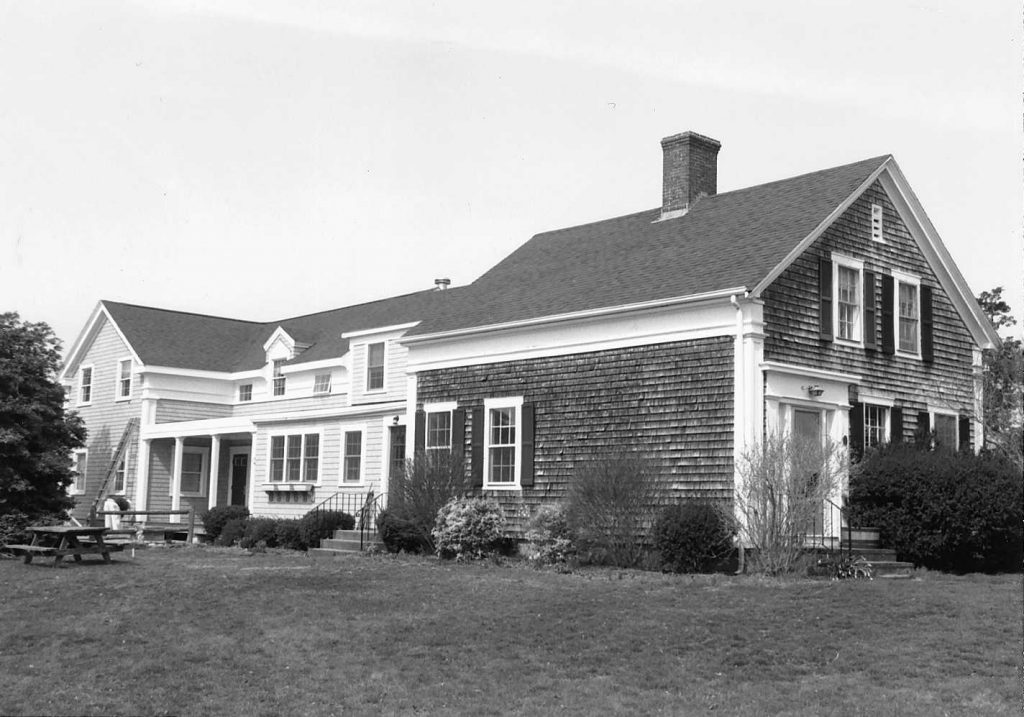
Marion (Old Rochester) is one of the oldest towns in the United States, and the Sippican Historical Society maintains an extensive collection of documentation on its historic buildings. In 1998, the Sippican Historical Society commissioned an architectural survey of Marion’s historic homes and buildings. Over 100 were cataloged and photographed. SHS will feature one building a week so that the residents of Marion can understand more about its unique historical architecture.
This installment features 260 Front Street, the Foc’s’le House. The building at 260 Front Street was built c. 1830 and was at one time occupied by the local stagecoach driver. It had been owned by the Allanach family when it was purchased by Tabor Academy.
While the engineering classes that normally fill the Tabor Academy MakerLab have all moved online, the building is still humming with activity. Since mid-March, the space has been taken over by the manufacture of face shields for donation to those who need personal protective equipment (PPE).
With news of a national shortage of PPE in the headlines, faculty members Karl and Susan Kistler knew that they had tools and the know-how to help. They soon began producing a design approved by the National Institutes of Health that involves both 3D-printed and laser-cut components. They have organized quite a production. In all, volunteers at Tabor have made over 80 completed masks and hundreds of components that will be joined with those from other makerspaces in New England.
When everything is working, 12 3D printers on campus contribute to this effort.
MakerLab coordinator Dr. Karl Kistler notes: “We’re lucky. Just before spring break, the Girls Advancing in STEM (GAINS) Club had just finished assembling two new printers for donation to Our Sisters’ School in New Bedford. The club members had been working hard to assemble the two 3D printers and organize a time to travel to OSS to present the new printers to the middle school girls and show them how they work. Since the OSS campus is also closed, we’ve decided to press the two printers into service until they can be donated. In addition, the Marion and Mattapoisett town libraries have loaned us their machines.”
A few others on campus have contributed to the PPE effort. A science teacher has set up four of the 3D printers in his dormitory common room and is running production there. Two other faculty families worked in their homes to attach a headband to each finished visor with rubber bands and zip-ties in order to keep the face shield in place. Another teacher will deliver mask components not used locally to a partner makerspace in Brookline for final preparation and distribution to Boston area hospitals. Dr. Kistler said, “As soon as we told the campus what we were doing, people came forward asking how to help.”
Susan Kistler has been handling logistics: “We’ve coordinated with the local Department of Health and have produced masks for the Police and Fire departments in Marion and (for) Wareham Pediatrics, as well as for people who are part of our campus community who have a need for the protective equipment. I’m also active with the Massachusetts chapter of Masks for Docs so our overflow goes into their stream for distribution outside our community.”
Kerry Saltonstall, Director of Communication said, “The Tabor community is so proud of the Kistlers for organizing such an effort across campus in support of our first responders. Our only disappointment is that our students could not be here to help coordinate the effort and run the production schedule, because this kind of responsive, creative service leadership is right up their alley!”
Here is a link to the design Tabor is making, should you want to get in on the action from home: https://3dprint.nih.gov/discover/3dpx-013359. Also, here is Susan Kistler’s email should you want to coordinate distribution of your shields through Tabor’s effort: skistler@taboracademy.org.
The meaning of “stick-to-itive-ness” was on full display when the April 6 meeting of the Mattapoisett Planning Board took place via Go-To-Meeting. After a bit of a slow start as each board member adjusted microphones, learned how to navigate the internet platform including muting and unmuting functions, the board opened the hearing of NextGrid, a solar development company headquartered in San Francisco. It took over three hours before the exhausted board members agreed to continue the hearing until May 4.
Daniel Serber, NextGrid, first presented the proposed solar array project back in November in the form of a Special Permit application before the Zoning Board of Appeals. After long presentations and abutter comment, primarily voicing strong opposition to a solar project in a residential neighborhood, that application was denied. NextGrid filed an appeal with the Massachusetts Land Court.
Jonathan Silverstein of KP Law, Mattapoisett’s legal representative, provided clarification on how the applicant, after being denied permitting by the ZBA could file an application for consideration by the Planning Board.
It was determined by the Town of Mattapoisett that a possible solution might be reached by allowing the project to be filed with the Planning Board. The town’s legal representatives met with the applicant’s legal team, it was learned in a follow-up with Mattapoisett’s Director of Inspectional Services Andy Bobola. He said that, given the possibility of a long and expensive legal process at land court with the possibility of the decision coming down on the side of the applicant, the town wanted to be able to have some oversight of the project.
“We can have site-plan review and input and the ability to condition the project,” Bobola told The Wanderer. He said that if the applicant won in land court, the town would have forfeited that option.
Silverstein said that previous solar projects sought and received permitting through the granting of special permits issued by the ZBA absent site-plan review by the Planning Board. He said that the appeal by NextGrid is pending in land court. The applicant’s appeal states, in part, that because the town does not have a solar bylaw, there is no method available to grant special permits.
“The Planning Board has more experience with engineering specifications… it was agreed between the parties that the appeal process would quit and the applicant would come before the Planning Board,” he said.
Silverstein also explained that state statutes grant special consideration when proposed projects in residential areas fall into categories such as religious structures, schools, and solar arrays. “Zoning bylaws may not prohibit solar,” he said. But he added Mattapoisett’s bylaw don’t speak to solar at all.
During the hours-long hearing, various technical aspects of the project were heard with opportunities for the board members to ask questions of any of the three members of the NextGrid team. Serber was joined at the virtual conference table by Chris King of the architectural firm Atlantic Design, Sandwich, and NextGrid’s attorney, Joseph Pacella.
The topics touched on stormwater drainage, scope of clearing, concerns around heavy equipment on the dirt roadway, Bowman Road, MSDS requirements for transformers, emergency-equipment ingress and egress capabilities, fencing, screening, and set-backs. Also discussed was the applicant’s willingness to post bonds for decommissioning and maintenance. Sums were not set at this time.
Serber stated that extra care and consideration for abutters had been taken.
”We have spent time getting to know the abutters,” he said. “They have been kind and invited us into their homes. We wanted to keep the project palatable to the community.” Serber said that turtles and other migrating animals would be able to traverse the property freely and that landscaping would include the use of pollinating mixtures.
King pointed out that earlier plans had been modified to allow greater distances between private residences and the two solar-array fields, and that one of the two areas planned for development had been reduced by several acres. He also said that comments by the Mattapoisett Land Trust’s peer-review consultant, G.A.F. Engineering, would be included in future plan modifications.
Public comment was taken in the form of written missives, but Planning Board member Nathan Ketchel said that continuances would allow for public comment in the public meeting format. King felt all public comment should be in written form versus verbal participation, saying in this way the applicant could respond in kind. King feared by allowing verbal comment at the next meeting a decision would be delayed. Ketchel disagreed, saying, “I don’t think we can put any kind of timeline on it.
“I’m not going to come in on May 4 and say (the public) can’t comment. There was a pandemic. I didn’t write this into how this year was going to go. Under current statute, we can go 45 days beyond the emergency order of May 4.”
Earlier in the meeting, letters submitted to the Planning Board by Aucoot Road resident Brad Hathaway and his daughter Jane Hathaway dated April 2 and April 3 included questions of the appropriateness of a solar array in a residential district, consideration of drainage and stormwater management in light of the downstream location of the project, intent of 1965 Master Plans that indicated development should be compatible with residential areas, and large investments on the part of the Mattapoisett Land Trust in partnership with donors, the municipality and other investors to conserve more than 400 areas abutting the proposed solar array property, a point that according to Hathaway, “defeated the purpose” of conservation efforts.
Comments from the Mattapoisett Land Trust were recorded in the public hearing but not read aloud during this meeting.
Also present at the meeting was Becky Zora, an abutter who said that due to audio difficulties she had not been able to clearly hear Silverstein and wished to fully understand how the project was being heard by the Planning Board before commenting. She was directed to the town’s website for full access.
Other agenda items including review of a new solar bylaw and language modifications to flood-zone bylaws were suspended until further notice pending town meeting’s scheduling.
The next meeting of the Mattapoisett Planning Board is scheduled for May 4 at 7:00 pm, venue to be announced.
Mattapoisett Planning Board
By Marilou Newell
The Marion Art Center is pleased to announce the launch of its new website. For many months the MAC has been working closely with the talented team at Design Principles of Marion to bring its visitors a fresh, interactive, user-friendly experience. See the Marion Art Center as it truly is – a vibrant, growing organization in the SouthCoast community. The MAC expresses its gratitude for the enormous generosity of the donors who made this project possible.
The MAC continues to promote creativity and conversation through a new endeavor called “the Virtual MAC”. While the Marion Art Center is closed to the public, you can stay connected through the MAC’s social media platforms (Instagram: @marionartcenter and Facebook: www.facebook.com/marionartcenter) and by visiting their new website at www.marionartcenter.org. Through these outlets, the MAC is featuring works of art, interviews, inspirational videos, and links to partner and community organizations. Stay engaged by submitting to the call for entries for an online gallery titled “Living Uncertainty.” The call remains open while the MAC is closed to the public, and new entries will be added weekly.
The current national and global situation has left many of us with immediate, unexpected challenges without knowing how to plan for the weeks and months ahead. Many feel isolated or worried about the future. Others are taking time exploring and making art, becoming closer with family, or experimenting in the kitchen – even if out of necessity. How are you coping creatively with this new social structure? How does it change for you day-to-day?
The MAC invites anyone to participate in “Living Uncertainty”. All forms of creative expression are welcome – poems or journal entries, visual arts, recipes, music, creative projects, and more. Entries will be featured in a virtual gallery on the MAC’s new website at www.marionartcenter.org/virtual-mac. Participants should submit all entries (high-resolution photos when possible) via email with the subject line “Living Uncertainty” to director@marionartcenter.org. Submissions should include information about the artist or creator and include a brief description about the artwork(s) when applicable. Share your ideas to become part of the conversation.
Patricia Mary (Jones) Hunt died peacefully at home among her family on April 10, 2020 in Rochester, Massachusetts, at the age of 87.
Patricia is survived by her daughters, Susan Duncan of Marion, Robin Sommo of Rochester, Joanne Hickey of New Bedford, and Sarah Aanensen of Rochester; her brother William Jones and his wife Mary, of Marion, 14 grandchildren and 9 great-grandchildren, and many nieces and nephews, all of whom she loved and cherished. She is preceded in death by her husband, Robert Edward Hunt of Marion, her daughter Linda Cooper of Marion, and her daughter, Judith Herman of Owings Mills, Maryland.
Patricia was born on November 20, 1932, in Baltimore, Maryland, to William and Eleanor Jones. She graduated from St. Luke’s Nursing School in New Bedford as a registered nurse, and married Robert (“Bud”) in 1953. They moved to Florida where he pursued a career in the Air Force and she as a hospital nurse. As Robert was transferred from state to state by the Air Force, Patricia worked in new hospitals and raised children. They retired to Marion, Massachusetts in 1969, where Robert went to work for Burr Brothers Boatyard and Patricia took a nursing position at Tobey Hospital in Wareham. She retired from Tobey after 20 years, and was the school nurse at Sippican School in Marion for 2 years.
Pat was an accomplished artist who loved painting landscapes and seascapes, particularly the whaling vessels that sailed in past centuries from New Bedford Harbor. She was skilled as well in knitting and crochet, and the receiving blankets she made were treasured baby shower gifts. Eventually she and her husband raised sheep, and she spun her own wool.
She loved history and archeology, and was a volunteer curator at the Marion Natural History Museum for several years. She served as secretary of the North Marion Methodist Church, and loved helping to prepare crafts for the annual Holly Fair. She was an avid fan of the Red Sox and the Patriots, and a skilled gardener.
Services will be private and will be followed later this year by a memorial celebration of her life.
In lieu of flowers, please send donations to Southcoast Visiting Nurse Association at 200 Mill Rd, Fairhaven, MA, 02719, or to It’s All About the Animals at 103 Marion Road, Rochester, MA 02770. The family would like to thank the Visiting Nurses Association for their dedication, care, and kindness.
Arrangements are by the Chapman, Cole & Gleason Funeral Home, 2599 Cranberry Hwy., Wareham. For online guestbook, visit: www.ccgfuneralhome.com.

The Marion Board of Selectmen has joined in with neighboring towns Rochester and Wareham in extending the property tax deadline from May 1 to June 1. Those who can pay their taxes in keeping with the May 1 deadline are asked to do so in order to spare the town any unnecessary financial strain.
“Unfortunately, on this tax bill, we have the (sewer) betterment fees,” said Marion Board of Selectman Chairperson Randy Parker.
Assistant Town Administrator Judy Mooney instructed the board that the waiving of interest is not a Board of Selectmen authority but falls under the treasurer/collector. Nonetheless, it will happen. “You’re extending the due date so she will automatically waive that interest,” said Mooney.
Department of Public Works Director David Willett researched approximately 50 municipalities and presented a revised street-opening permit for the board’s approval.
The purpose is to make contractors more accountable to the town. It has a bonding requirement, and documents and amounts have been discussed with insurance agents. At present, Marion has neither a bond requirement nor an insurance requirement.
Board of Selectmen member John Waterman said that, while the new permit proposal includes bonding, some of the procedures outlined are difficult to understand or buried deep in the document.
Parker was happy to see flowable fill addressed but was unable to find compaction rates. His main concern was for someone filling a sewer box. “This is great coverage if you’re doing a $100,000 job, but if you’re doing a $5,000 job, it’s a little burdensome,” he said.
“It’s really the little contractor that I’m trying to get to here,” said Willett, alluding to the many small projects and the town’s policy to inspect them. “There’s not enough time of the day to go out and inspect all those things.”
It is hoped that more stringent accountability to meet requirements will lessen the load on the town. Willett said he is “more concerned with their personnel falling into a trench or getting hit by a car.”
“This is what we’re asking them to do – spend a little more time. You drive down the street and there’s a thousand little dig-ups, and most of them are Eversource,” said Willett, who established a blanket bond with the utility company. “Normally I don’t like blanket bonds; I said $50,000 and they didn’t blink an eyelash.”
Willett compared Marion’s revised permit as being similar to North Reading’s “street-opening permit.” The bond, he said, is typically two percent of the cost of the work. Marion issues approximately three dozen permits a year. Willett is asking all of the town’s designers to put two-year warranties on all of their projects instead of the (customary) one year.
“This isn’t a big revenue-catching thing,” said Willett, who considers the measure a “first step” in the pavement-management program.
The concerns of the Board of Selectmen varied.
“I’m a firm believer in inspecting work,” said Clerk Norm Hills. “If there’s something that works, let’s just tell them to use it.”
“We need to understand this process and minimize it for our smaller contractors,” said Waterman.
“I’m trying not to create a place in Marion where we have one or two contractors,” said Parker, citing the importance of simple regulations, an authentic bidding process and the avoidance of a monopoly.
McGrail said that, since the board is voting on April 21, he will obtain the relevant information regarding bond procedures. McGrail also said putting off a vote for two weeks will allow the town to get public comments on the matter. Residents can email McGrail at jmcgrail@marionma.gov.
Dr. Ed Hoffer, the vice chairperson of Marion’s Board of Health and a practicing physician, attended the meeting to explain the closure of beach parking lots in Marion.
“You read the (Boston) Globe or The New York Times or whatever newspaper and you know we’re heading into… the worst days coming,” he told the meeting. “There are still no vaccinations, no proven treatments. We’re trying very hard to limit the disease, and all we’ve got is masks, handwashing, and social distancing.”
Hoffer found that people at the beach were not maintaining social distance. “You could set up 20 at a time for Silvershell (Beach), but we wanted to keep it down to people within walking distance.”
Having seen a half dozen people walking at the beach since the closure of the parking lots, Hoffer was pleased. “We don’t want to keep people away from Silvershell; we just don’t want them packed so tightly,” he said.
Hoffer and McGrail contributed to a public service announcement for the town.
Citing the guidance from the governor and the May 4 target date to reopen public facilities, McGrail said he would be working with Hoffer within a few weeks on how to get the beach back open under some hours or schedule.
Marion secured a $5.765 million bond for lagoon work, wastewater treatment plant and other projects including the Mill Street water main.
“We did good on this one,” said Mooney, reporting a 1.4 percent long-term loan.
In other business, the Board of Selectmen voted to continue Fieldstone Market’s application for a license for the retail sale of win and malt beverages for 60 days per town counsel’s recommendation to June 9 at 7:15 pm.
The board denied the request for an abatement of $200 for a residence owner on Pine Hill Lane, whose water-meter reading was in failure since February 2018. The entire water bill is approximately $1,221.
McGrail will be the primary representative and Parker secondary in Marion’s actions that allow residents the option of choosing their own electricity carrier.
The contracts of inspectors of animals Sue Connor and Adam Murphy were renewed, effective for the next physical year.
The Marion Board of Selectmen will meet at 3:00 pm on Thursday, April 9, and vote on a proposal to postpone town meeting to a date no later than June 30 and with at least 20 days’ notice.
Marion Board of Selectmen
By Mick Colageo
Superintendent of Schools Doug White praised the tech department while discussing a district-wide shift to remote learning during the April 2 online meeting of the Rochester Memorial School Committee.
On April 3, White wrote a letter to the Tri-Town Communities stating that all six schools in the Old Rochester Regional School district were shifting to a remote-learning model. Furthermore, all staff members have been busy drafting remote-learning plans to share with parents, guardians, and students.
ORR’s goal is that students can learn on and offline while away from the classroom until at least May 4 per state order.
“We’re having dialogue about what that may look like and what we might do,” White told the Rochester School Committee assembled via video conference online. “Remote learning isn’t just a virtual experience… it could be a large group of people getting together. It could be an audio-conference, it could be a 1-to-1 student (session)… We’re trying to get that message out that it’s not just screen time or time with the teacher.”
According to White, ORR is looking at a schedule of three hours only on the backs of their classroom teacher, roughly half the time of a school day. “Another thing that we’re asking is that teachers provide an hour of office time available to their families (i.e. office hours),” he said.
This could be done by phone or via phone apps, computer programs or email, he said.
Committee member Tina Rood suggested that there be one guaranteed place where families will know how to connect to a teacher. “We’re in what is a crisis with the families,” she said.
White said the schools are already in such an active communication that the school will be the side performing regular maintenance of those situations.
Principal Derek Medeiros said Rochester Memorial School will continue posting messages to remind families that this communication is being promoted.
White told committee member Sharon Hartley that families would be advised as to how the day will proceed and the online platforms.
“We have teachers who are using email and teachers who are using a website,” said White, who said work is ongoing on professional development for support of teachers to mobilize them. “We’re going to make mistakes and we’re going to do better.”
White acknowledged the changing goals with the passing of time since it became apparent school would be out beyond the original prescription of April 7 to the present order of May 4.
“We’re just under 300 Chromebooks lent out over all of the districts; that’s a continuing opportunity that we’re offering our students,” he said.
Hot spots are also being addressed and alternative means of internet linkage.
“Our teachers feel comfortable with the platforms that we’re using,” said Medeiros. “I think everybody’s going to be a Zoom expert.” Jokes aside, Medeiros says online tutorials are being researched and sent out to teachers to support their efforts.
Assistant Superintendent Mike Nelson suggested that if people visit the ORR website or any of the school webpages, then move to the Staff Resources tab up top and click on “PD for School Closure,” it will show the programs and resources that the ORR District is offering.
Nelson discussed special education, noting immediate meetings upon the March 13 closure of schools, beginning weekly check-ins with homes and offering students newly needing social and emotional support to engage Central Office.
“Our priority is providing as many services and support to our families as we possibly can, knowing that they’re not going to be looking the same,” said Nelson, who went on what he called a “Zoom marathon” to reach out to families with students with disabilities.
Screen time was also discussed by the committee, acknowledging the necessary byproduct of online learning being additional hours spent by children at their computers.
In his report, White thanked the ongoing work of cafeteria in ORR schools for the 145-170 lunches distributed per day. White said ORR will move to an every-other-day schedule to limit exposure by staff. There is no interaction between staff and those picking up lunches. Staffers maintain separate stations while working to prepare lunches.
“There had been conversation about reimbursement… We’ve lost the ability to collect funds,” said White. “Just over the weekend, the (federal government) announced that they will cover it… Our cafeteria workers are not supported through our budget. We will keep you posted with that.”
People who pick up meals receive lunch and breakfast for the next day.
Classrooms are being cleaned more intensely and regularly and, if used, are being sanitized again. “We’ve been doing that in all three towns,” said White.
Following the March 13 school closure, Medeiros reported having allowed teachers to come back into school to gather belongings for the ongoing absence.
“I want to acknowledge that we are paving the road as we are walking on it, and we are walking on it,” said Hartley when opening the meeting. “I’m proud of many of the things that have happened in the past few weeks with our students, our children and their families. Thank you, everyone.”
Class assignment for the 2020-21 school year in all ORR schools will be moved to mid-August, Medeiros confirmed, and March 12 meeting minutes were approved.
The April 2 meeting began with committee approval of the appointment of Laurie Walsh as new recording secretary.
The ORR School Committee is scheduled to meet on April 15.
Rochester Memorial School Committee
By Mick Colageo
The Massachusetts Division of Marine Fisheries has notified Mattapoisett that shellfish growing in Mattapoisett Harbor no longer meet established criteria for the harvest of shellfish due to seasonal water quality changes. The closure went in effect on April 1, 2020.
The closed area is defined as “Cove East of the Town Landing” in the official notification, and reads, “The waters and flats of that portion of Mattapoisett Harbor, east of the mouth of the river and south of a line drawn from the ‘No Shellfishing’ sign at the northern mouth of the Mattapoisett River to the ‘No Shellfishing’ sign at the eastern entrance to the cove.”
The area will remain closed between April 1 and December 31, 2020. On January 1, 2021 the area will revert to open status for shellfishing. For more information contact Kathy Massey, Animal Control and Shellfish Officer at 508-209- 4931.