Academic Achievements

Adam Sylvia of Rochester, was one of more than 700 students at Central College who would have been honored at the college’s annual Scholarship Celebration on Thursday, April 23. The event was canceled because of the coronavirus pandemic. The Scholarship Celebration in P.H. Kuyper Gymnasium gives student scholarship recipients the opportunity to personally thank and share dinner with donors who help make their Central education possible. Sylvia received the Journey Scholarship.
Benson Brook Solar Array Not a Done Deal

            The contracts have been signed and Marion is committed to go forward on deals that, if the costs work out with Eversource, would result in a potentially profitable solar array atop the Benson Brook landfill. But the Marion Energy Management Committee intends on second-guessing the plan when the Board of Selectmen meet on Thursday, April 30.

            “This was originally sold to us as benefitting the town with solar… I feel like it’s leaving this part of the project’s design behind… I’d like to hear why this wasn’t discussed. Why haven’t we kept that in the track?” asked Committee member Jennifer Francis during the committee’s April 27, remote access meeting.

            Liz Argo, participating in the meeting on behalf of Cape and Vineyard Electric Cooperative (CVEC), qualified her remarks by recognizing it as an “internal town discussion,” but said the original plan was more expensive in terms of management and the lack of financial incentives. “It was looked at. I can go out on a limb as an outsider and say it was a financial decision,” said Argo.

            Marion joined CVEC last year for the purposes of expert facilitation of such a venture.

            Francis pointed out that, under the original concept, residents were going to be able to buy shares in solar power over a 10-year period and pay a reduced rate. “The town wasn’t going to benefit as much as our budget for the town, but residents were going to benefit more. That’s the story that we told at (2019) Town Meeting, and that’s what we got approved,” she said. “I understand now the payment to the town is not peanuts so it could be it’s better to have this money going into the town coffers than going to the residents.”

            Last week the Board of Selectmen authorized Town Administrator Jay McGrail to sign contracts with CVEC to manage the arrangement and with developer Distributed Solar Development.

            DSD was judged the best of three bids to build on the Benson Brooks landfill site because the company offered a straight lease, which suited Marion’s financial portfolio. The nature of the contract directs the funds to go into town coffers rather than straight to residents. The new arrangement results in approximately $125,000 per year for Marion for the 20-year life of the contract.

            “I think from (Mr. McGrail)’s perspective, he was looking at the best deals and how much Marion would make… I know we did compare both options at one point, and the revenues on community solar was really, really low,” said Town Planner Gil Hilario.

            The greater difference as it affects the lease now appears to be related to the timeline, as in the sooner Marion enters into agreement the better the potential financial windfall. This is due to what Argo called the “first-come, first-served” nature of market.

            According to Argo, back in December the project was in Block 3; now it’s in Block 5. Due to the effect of the passage of time and the race to grab state-sponsored incentives, the 20-year lease agreed upon is down from $149,000 to $125,000.

            Adding to the complexity is the next stage in which a study will reveal the cost of interconnect with Eversource. If Marion finds that price too high, it can back out of the whole deal.

            Committee Member Christian Ingerslev noted that towns are starting to put solar panels on reservoirs.

            Argo discouraged the idea for Marion. “Environmentalists are concerned because now you’re cutting off the sunlight,” she said. “It wouldn’t help Marion because you’re not being challenged to develop solar (energy); you’re challenged (as to how) to use it.”

            Argo reminded the committee that all conversations need to happen sooner rather than later, as any delays erode the financial incentives.

            Originally conceived for the purpose of bringing wind power turbines to the town to save money on electricity, Marion’s Energy Management Committee now deals with multiple, alternative-energy sources in both the private and public sectors. In this case, the committee is advocating for the citizens and would like to hear from McGrail himself on the matter.

            Committee Chairman David Pierce thinks it would be best to “put our 10 cents into the discussion. I think it would be helpful. This is not a done deal even though the contract has been signed,” he said.

            After Hilario gave a Green Communities Update (see Marion Board of Selectmen story), Committee member Bill Saltonstall updated the group on the Mass Energy Insight program, noting that while LED lights had been installed and were working on South Street and Ryder Lane, Eversource was still charging Marion for high-pressure sodium lamps.

            The goal in the program has been to save 25 percent in a five-year period, but there is only a two percent savings so far. “I’m trying to chase them… (it’s) still a work in progress,” said Saltonstall.

            The next meeting of the Marion Energy Management Committee is scheduled for June 8.

Marion Energy Management Committee

By Mick Colageo

University Life in an Alternate Universe

            They were living the American dream, enjoying campus life, friends, studying, pursuing goals and dreams, and maybe thinking about Spring Break. Then the entire world as we all knew it came to an abrupt stop – COVID-19 had arrived.

            College and university students may be a population that is a bit invisible right now. Yet they represent the future, the leaders, the workforce, musicians, doctors, and policy-makers. They will one day be the decision-makers. How the current global emergency shapes their lives will only be known through the lens of time. For now, they are showing their mettle in ways that may be surprising to themselves and their families.

            The Wanderer spoke to five students to check-in with them and find out how the current situation is impacting their daily lives and their studies. 

            We spoke to Danielle Coderre, 24, a first year medical school student at the University of Massachusetts School of Medicine in Worcester. Coderre graduated from Fairhaven High in 2014, graduated from the University of Rhode Island, and then was accepted to UMass Medical School in 2019.

            “Tori” Victoria MacLean, 21, is a third-year English Education major at Westfield State University. MacLean graduated from Old Rochester Regional High School in 2017.

            Emily Newell, 21, is a third-year Humanities major, first at Bristol Community College, then transferring to the University of Southern Maine, and is a 2017 graduate of ORR.

            Davis Mathieu, 21, is a third-year Marine Engineering major at Massachusetts Maritime Academy and a 2017 graduate of ORR.

            Max Wolski, 21, is a third-year Music Education major at Berkley School of Music and also a 2017 graduate of ORR.

            When asked what the biggest change to her studies, Coderre said it was not being able to be in the laboratories. “Class lectures are online and also available after they are given so that’s not so bad,” but she added, “…any classes that require group problem solving are lost.” She explained that she participates in anywhere from three to six lectures per day as well as printed materials, most of which was already accessible online. But the issue of isolation for her didn’t factor in as much as it did for the other students. “My course of study can be pretty isolating anyway,” Coderre said. “It’s my job to learn the material… I’m self-directed.” But personal relationships are important. “I talk to friends on social media every day,” she said.

            Coderre’s medical studies gives her insight to which the average person may not have access. With all that she has learned about infectious diseases and public policy, she now believes the number-one takeaway from this emergency is preparedness. “Always plan for the worst-case scenario,” she said, identifying a lack of cohesiveness between public-health agencies as problematic and in need of being addressed before future global-health issues arise.

            Asked how the students at the medical school are responding to the need for volunteers, Coderre said, “We are not required to do anything… but we can volunteer.” She said that some students were calling senior citizens to access their needs, while others were doing more hands-on work such as fitting masks. “There are higher-risk situations such as aiding the homeless population… we all wish we could do more, but it’s also important that we stay safe.”

            Coderre’s advice to other students: “Continue to tackle the work.” She said in her course of study being willing to sacrifice is paramount. “I’m willing to give up some personal life, but I do keep things in balance,” she said.

            “It could be worse… it’s day-by-day,” MacLean said. Her training as a resident advisor came into play in a big way during the days her school was shutting its doors. “My first thought was for the students,” she said. As an RA, MacLean’s responsibilities run the gambit from consoling those who are homesick to fire drills and medical emergencies. Understanding the students’ background and needs is also important to MacLean. “Some students didn’t have a safe place to go when school closed,” she said. Others, she found, had nowhere to go. There are year-round housing opportunities at Westfield, but those evaporated with the shutdown. “I was initially very worried and scared, not for myself but for some kids,” she said.

            MacLean also talked about her own studies. “I love learning; that’s me.” She said that going from full speed to nearly a dead-stop has been a difficult transition. “It’s a shock, not much learning, things feel stagnant,” she said. “I’d give anything to be in my driest class right now.” But she pushes on with online classes, while admitting that the absence of discourse with classmates makes things tough. “You can’t bounce ideas around.” She said that those students who were receiving educational accommodations were finding the solely online courses difficult.

            As for social media, MacLean said, “I don’t know what I’d do without it!” Regarding her studies, “I’m trying to finish strong.” But it’s a big adjustment being home. “I’m not the same person I was in high school,” she said, acknowledging a greater perspective. “I’d tell (high school) students, ‘Be kind to yourself… talk to your professors… don’t worry about the future right now… focus on classes.’”

            Mathieu is finding online classes lacking. “I need the labs, the hands-on experience to understand how things operate… Watching videos, it’s just not the same impact – some of my classes are real-world situations. I need that as a marine engineer,” he said. Not being able to be in class working with others troubleshooting and understanding complex mechanicals, “… impacts how I’m learning,” said Mathieu, noting that the school may institute some make-up classes once the campus is reopened. “It’s going to be very difficult to complete a full college load, full Coast Guard load, and make-up labs.” He said in the spring of his senior year (2021) there are Coast Guard exams that he must pass in order to receive licensure. Mathieu expressed concern over missing out on the Coast Guard practical courses. “We can’t do those now,” he said.

            Mathieu’s frustration and concerns haven’t slowed him down in terms of doing all he can now. “I’d tell other students to hold on… ‘Don’t let this cause you to fall behind… study, get good grades and don’t get complacent.’”

            Newell is finding the transition home to be isolating. “I was in a dorm room with two great friends and my college best friend was just across the hallway… I miss them,” said Newell, in her first year of a campus life and course load she was enjoying while living on her own.

            When the University of Southern Maine closed, Newell became frustrated over the mixed message the students were receiving. “We didn’t know what we were supposed to be doing,” she said. When they were finally told they wouldn’t be returning to school after spring break, the logistics of moving out of a college dorm proved challenging. “All my plastic totes were at home… I had to make many trips back and forth filling my car up with a year’s worth of stuff,” she said with a chuckle.

            Once home, Newell was ready for the online model of studying, having taken several classes over the years that were offered exclusively online. “But it is difficult… it’s hard to stay focused,” she admitted. “Having one or two classes online isn’t bad, but not all of them.” Newell said the Zoom meetings were the best and offered more interactive opportunities. “Those work really well.” Other forms of communication are also helping to buffer the lack of vis-à-vis exchanges. “We correspond via email and discussion board,” she said, noting that the quality of the exchanges is lacking. “Looking at screens for long periods of time is not easy.”

            For Newell the feeling of isolation can make getting through the days difficult, but it hasn’t slowed down her desire to finish the year to the best of her abilities. “I’d tell others just to keep going, we’ve made it this far, don’t stop now.” She also shared an analogy she learned from her years of National Youth Leadership training with the Boy Scouts of America. “You can only eat an elephant one bite at a time so just keep going; don’t give up.”

            Wolski said that he is finding the workload and time commitment about the same as when he was in class at Berkley. “Early in the year plans are laid out,” he said, so the schedule is holding. But, “… the environment is different… home meant time to relax.” Now being home means remote learning, but for Wolski, this hiatus from school also means a loss of performing, a big part of his curriculum. Not only have opportunities to intern in grade-school settings dried up, but all group venues have been canceled or postponed. He said that camps or workshops he might have worked during the summer are gone.

            But Wolski is another student who isn’t letting loss frame his thinking as he moves forward. His ability to wax philosophically while keeping focused on his workload seems to be one way Wolski is coping. “People need to understand that this is temporary,” he said, noting the importance of social distancing and setting limits on gatherings. “It’s important to fight this thing. Younger students will have time to experience the campus lifestyle,” he said. Wolski also made a statement that could just as easily been a hope. “This whole thing, it’s showing that people can adapt and learn,” he said.

            Editor’s Note: Danielle Coderre and Emily Newell are related to the author of this article.

By Marilou Newell

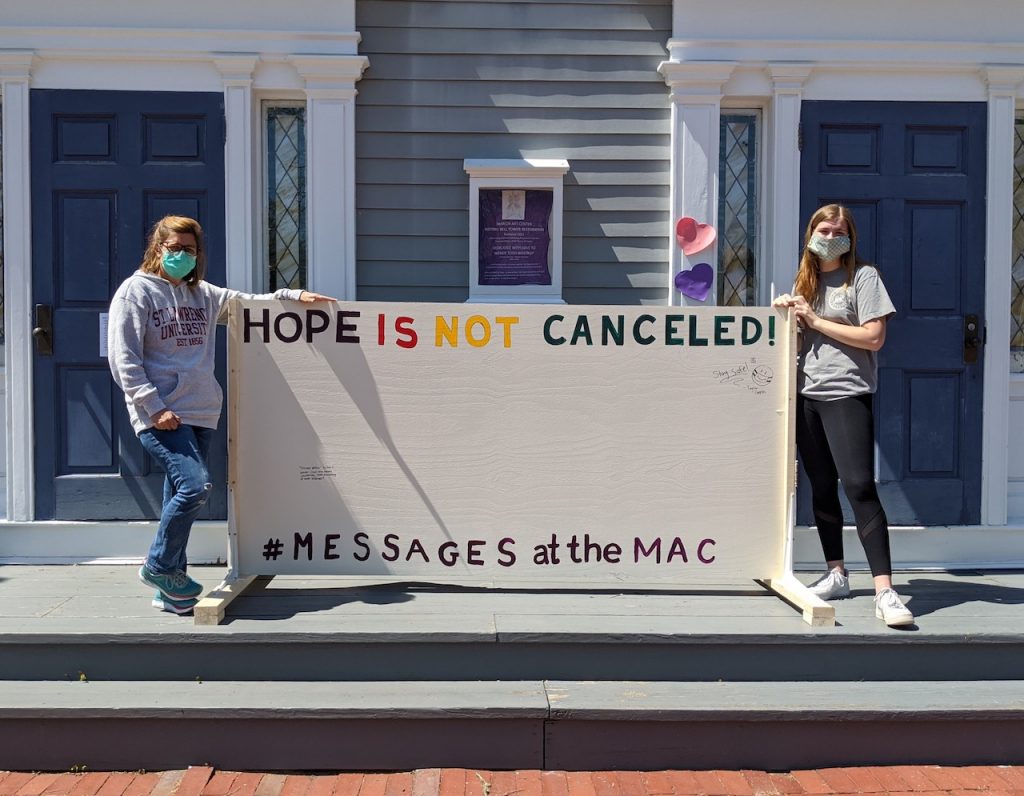
MAC’s Community Message Board

The Marion Art Center invites you to add to the MAC’s Community Message Board.

            • Bring your own paints, pens, markers.

            • Add your drawing, painting, poem, or inspirational words. Remember, we want to keep it positive! 

            • Please be respectful of others. Play it safe! Wear a mask and keep at least six feet of distance if others are present.

            • Take a photo and email it to info@marionartcenter.org with the subject line: “Messages at the MAC”

            • Upload to social media and be sure to follow and tag @marionartcenter #MessagesattheMAC #theMAC

            • Tag others, share with others, invite friends and family to join the conversation by adding to the board

            • Stay connected at #theVirtualMAC by visiting us online at www.marionartcenter.org

Althea Isabel (Morse) Lawrence

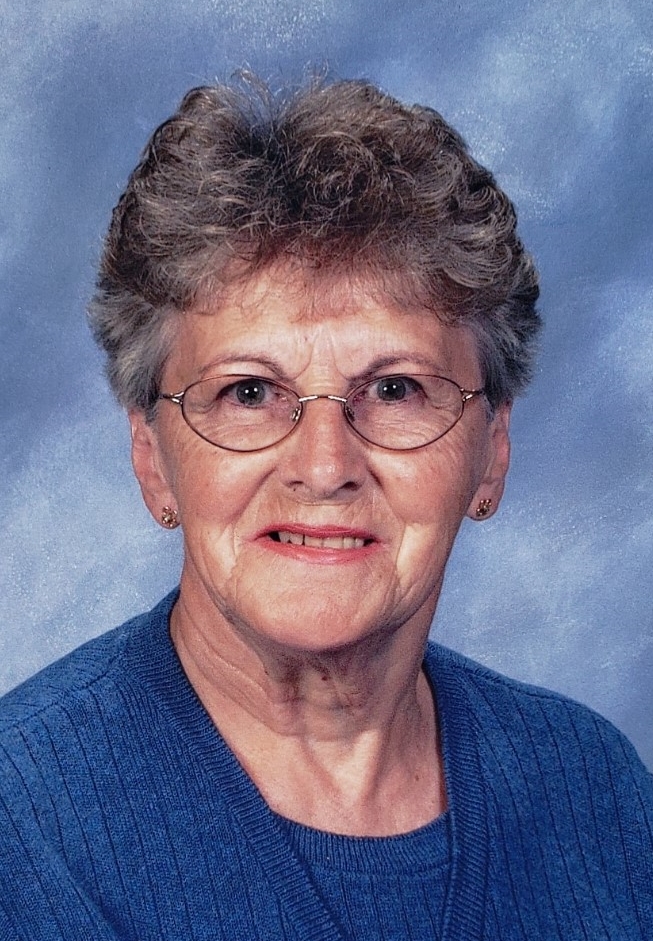
Althea Isabel (Morse) Lawrence of Rochester, passed away Tuesday, April 28, 2020 peacefully in her home. She was born on July 3, 1928 in Acushnet, the daughter of Herman Morse and Clara (Ellis) Morse.

            Althea is the mother of Wayne B. Lawrence of Fayetteville, GA, Susan Althea Lawrence McCombe of Wareham and the late Jo-Ann Lawrence Frazier. She is survived by nine grandchildren, 14 great-grandchildren and 2 great-great-grandchildren.

            She graduated from the New Bedford Vocational School and married Nathan Lawrence in 1947. Althea worked as the dispatcher for Rochester Police and Fire Departments operating the dispatch center from her home in the late 1960’s though the 70’s and became the chief dispatcher from 1980-1990 when the dispatch center was moved to the Rochester Fire Station. She served as a police matron for the Wareham Police Department from 1967-1980.

            She loved to knit, cross-stitch, bake, read and feed the hummingbirds. The family would like to thank so many people that have helped her in the past few years through their visits, collecting her mail and bringing her meals. It means so much that she was loved by so many.

            Due to the current health crisis, there will be a private family graveside service held at Center Cemetery in Rochester.

            Donations in the memory of Althea may be made to Wareham Police Department, 2515 Cranberry Hwy., Wareham, MA 02571, Rochester Ambulance Fund, 1 Constitution Way, Rochester, MA 02770, or Community Nurse Home Care, 62 Center Street, Fairhaven, MA 02719.

            Arrangements by Chapman, Cole & Gleason Funeral Home, Wareham.  To leave a message of condolence visit: www.ccgfuneralhome.com

Climate Reality Meeting

Honor the 50th anniversary of Earth Day by joining Climate Reality Massachusetts Southcoast’s online Zoom meeting on Monday, May 4 at 6:30 pm (info below).

            We believe there’s an urgent need for climate action at all levels of society. On May 4, we’ll discuss our “100 Percent Committed” climate action campaign, which aims for 100 percent participation in renewable energy by 2030 across every sector in the region. 

            Please join us on Monday, May 4 at 6:30 pm as we plan our work with local officials and regional green/sustainability committees to build support for “100 Percent Committed.” Scientists tell us we have ten years to make the switch from fossil fuels to renewables to avoid the worst impacts of climate change. The stakes couldn’t be higher, and quickly moving from brown to green energy will reduce our region’s future costs for rising sea level mitigation, environmental degradation, and natural disaster recovery.

            Please visit: bit.ly/joincrsc, or email crmasc2019@gmail.com for more information.

David C. Dionne, Jr.

David C. Dionne, Jr. age 59 of Rochester, Ma passed away on April 26 at St. Lukes Hospital after waging a courageous battle with cancer. He was born in Medford, Ma to Emily and David C. Dionne, Sr.

            David grew up on the water in Mattapoisett where he developed his life long love of the sea. As a boy he enjoyed rowing his boat, blue crabbing, scuba diving, and everything else on or in the water.

            He graduated from Old Rochester Regional High School. He then served in the Coast Guard from 1979 to 1983 patrolling the waters of the eastern United States. After his service he worked locally as a stone mason. Later he had his own business “Green Mountain Masonry in Denver, Colorado.

            In his 40’s he returned to college and received a Bachelor of Science degree in Business Administration from Fitchburg State College.

            Most recently he lived in Gardner, Ma and worked for Frito-Lay.

            He is survived by his mother Emily Dionne of Rochester, a sister Heather Dionne of Nashua, NH, a brother Bruce Dionne and his wife Karen from Fairhaven, Ma, and a beloved niece Amique Dionne, and her children, Noah and Emma. Amique was a great comfort to David in his last days and hours of his life.

            He was predeceased by his father David C. Dionne, Sr.

            David will be placed to rest privately at a later date.

New Fire Station Contract Goes to Rubicon Builders

            The April 22 meeting of the Mattapoisett Fire Station Building Committee welcomed a full teleconference meeting room with the following voices: Brain Fors of Vertex, construction project management; Chris Logan and Jeff Shaw of Contex architects; Mattapoisett Fire Chief Andrew Murray; Mattapoisett Police Captain Jason King; Town Administrator Mike Lorenco and town consultant Mike Gagne; committee members Fire Captain and Selectman Jordan Collyer; Director of Inspectional Services Andy Bobola; Chairman Mike Hickey; and committee member Bill Cantor.

            The big line item on the agenda was the awarding of the general contract bid to Rubicon Builders of Mansfield. Fors described the review process employed in moving Rubicon to the head of the line after evaluating eight bids. He said, “…we reference-checked past jobs, called multiple private jobs (and) checked with owners and architects.” Logan said, “The majority were very high on their work and the owners’ engagement on jobs.”

            Hickey noted in a follow-up that there had been concerns that on-site management had changed, which didn’t allow for the level of continuity the committee wanted. “We were assured personnel changes would not be a problem… there were no performance concerns from the references,” he said.

            During the conference call, Hickey stated, “Recommendations and reference checks tell the bigger story.” Gagne concurred, saying the report from Vertex had been “thorough.” Logan added that a pre-construction meeting would address any lingering concerns.

            Attached to the bid documents were “alternate” bids for apparatus flooring. Alternate One with an approximate price tag of $129,000 for in-floor heating and Alternate Two for an epoxy topcoat at $69,000 were both approved as part of the bid contract based on the overall projected building cost of $7,487,505. Hickey said that would leave about a 10 percent contingency for all the other must-have items for the new station to be fully operational.

            Regarding the fire station flooring, Hickey explained that a heated floor would allow water to evaporate more quickly, adding longevity to the flooring material as well as drying the undercarriage of the vehicles which also helped to prevent rusting, not radiate heating for the room. The epoxy coating was another added level of protection to the flooring, he said, especially against oil and other petroleum products.

            Hickey noted that at the April 16 meeting of the Board of Selectmen they voted to give bid-contract, signing authorization to Lorenco after receipt of a letter of intent to award the contract that the town administrator will author.

            Moving on to the issue of new traffic-signal placement on County Road, the final design has been received to date but concepts, Hickey said, were being drafted and reviewed. Also pending was the placement of a new crosswalk. Hickey said that the Massachusetts Department of Transportation had not permitted new curb cuts along County Road but had confirmed that site work could begin in advance of official permitting.

            Bobola asked that a set of as-built construction drawings be forwarded to his office once available.

            Hickey told the assembled that an independent commissioning agent charged with the responsibility of reviewing all mechanical and electrical aspects of the project would also be hired. Those bid estimates were not yet available, however.

            There was some discussion regarding the installation of video cameras for security and archival purposes. King would look into what was currently available from the Police Station and work with Murray to seek out other options. Murray thought it would be advantageous to document the construction project in this manner.

            The next meeting of the Mattapoisett Fire Station Construction Committee is scheduled for May 5 at 4:00 pm with posting of call-in numbers on the town’s website, www.mattapoisett.net.

Mattapoisett Fire Station Building Committee

By Marilou Newell

Snapping Turtles Lay Eggs in May

            From our panoramic picture window on the coastline of Sconticut Neck in Fairhaven, we welcomed the avian parade of migratory birds along the Atlantic Flyway, arriving to begin the nesting egg-laying April ritual reproduction. However, the month of May will be the month when the reptilian Snapping Turtle will rise up from muddy bottoms of brackish river tributaries to trek overland to similarly lay eggs.

            First, the female must meet the male on dry land to mate and fertilize her eggs. However, Mother Nature has already bestowed upon her a woman’s prerogative to change her mind. If she finds that reproductive atmospheric or environmental conditions are not exactly right for her eggs, she is blessed with the innate ability to store the male’s sperm in her reproductive organs until she feels her time is right.

            Case in point, scientific research reports find how her eggs incubated at about 65 F degrees produce only females, 73 F degrees produce both males and females, and 75 F degrees only males. Once she feels comfortable in her heart, she must head overland for as far as a mile or more, as well as crossing a country road or two, in plain sight for onlookers. She may return to the same sandy hillside used last year.

            In less than a single day, she may lay as many as 30 to 40 eggs, as illustrated, and use her tail to bury them in sand out of sight from predators. All too often they are found and dug up by hungry skunks, raccoons and crows. If her buried treasure trove has been dug up upon her return, she somehow knows not to use it again.

            Once she has laid and hidden the eggs, she immediately takes off to return to the path she came on, to the very waters of her departure.

            Her motherhood is finished, and her hatchlings left to fend for themselves. They will, in the fall, emerge from their leathery containers using a small egg tooth to break the shells. They will be about three-quarters of an inch long, with a cute little turtle-like impression and a face only a mother could love.

            As their mother departed in one day, they, too, will take off as soon as they are free to go, tracing her path to head to the nearest direction of the safety of water. Once their shells harden, their chances to live a full life of some 10 years improve, but only 10 percent of eggs laid grow into maturity.

            Egg-laying production is an ancient reptilian ritual, giving them the Latin classification of Chelydra serpentina, perhaps named after the evil serpent in the garden of Eden, mankind’s cross to bear.

            The Snapping Turtle is among the oldest creatures on Earth, even before the Mesozoic age of dinosaurs. They probably were among the original forms of living things that crawled up on land from the primordial soup that produced life-like creatures in the ocean.

            If you should come across a Snapper crossing a road, please do not waylay or disturb its reproductive intention. You will be witness to Mother Nature’s ancient renewal to ensure an unbroken chain of evolution for your own prodigy to read about and environmentally appreciate.

By George B. Emmons

Mattapoisett Annual Town Election Information

The Annual Town Election is scheduled for Tuesday, May 19, 2020 at Old Hammondtown School. We understand that many people are concerned about the current public health situation. Therefore, we are encouraging voters to request absentee ballots by mail. This way, your voice can still be heard without the worries and anxiety of exposing yourself to any illnesses. Please visit the Town website for updated information regarding the election or to request an absentee ballot. You may also call the Town Clerk’s Office at 508-758-4100 x 2 to request an application for an absentee ballot. Please consider requesting your ballot now because we must receive the voted ballot from you by the close of polls on election day for your vote to count.