Laura Eva “Smith” Lebeau

Laura Eva “Smith” Lebeau, age 66, passed on August 27, 2018 at home in Fall River after a lengthy illness. She was born and raised in Rochester, MA.

Laura was proceeded in death by her parents Alexander J. Smith and Marjorie M. Smith, her daughter Laura Ann Lebeau, and her brother Joseph A. Smith.

She is survived by her companion of 22 years Cliff Niles, her daughters Sherry Thomas (husband James), Sue Ann Lebeau, and son Frank Lebeau; sisters Cecelia Hall (husband Rick), Eleanor Galligan, Marjorie Higginbotham.; grandchildren Courtney Agrella, Chelsey Agrella, Joshua Lebeau, Alyssa Krebs, Laura Viera, Brittney Lebeau, Brandy Lebeau, Kayla Thibault, Kyle Thibault and Kilee Thibault; six great-grandchildren; aunt Eileen Perini (husband Frank); several nieces, nephews and cousins.

Per her request, a private graveside service will be held in October at the Acushnet Cemetery.

Hormidas R. “Butch” Boucher

Hormidas R. “Butch” Boucher, age 99 of Rochester, passed away on Tuesday, September 4, 2018 in Nemasket Healthcare Center in Middleboro, MA, surrounded by his loving family. He was the husband of Doris (Barrett) Boucher to whom he had been happily married for 71 years.

Born in New Bedford, youngest child of the late Victor and Laura (Cote) Boucher, he was a longtime resident of Rochester. He was a graduate of New Bedford Textile School class of 1938. Butch was a pioneer of UMass Dartmouth, as New Bedford Textile School’s merger with SMU, later becoming UMass Dartmouth. After graduation he worked for 5 years at the Torpedo Station in Newport, RI as a First Class Machinist. In 1944, during WWII, he joined the U.S. Navy as a Seaman First Class in the Submarine Service, Pacific Fleet serving aboard the NTC Sampson and later the USS Thresher. He was employed at the Acushnet Co. as a foreman in the Machine Shop, where he retired from after 31 years of dedicated service.

Butch loved his family dearly; both he and his loving wife gave generously their whole lives. They instilled high moral values in all of their children and a strong sense of charity to others. He was a life member of the Rochester Lions Club, serving as treasurer and King Lion, receiving the Melvin Jones Award from Lions International for dedicated humanitarian services in 1995; he was a member and past President of the US Submarine Vets, WWII, Baystate East Chapter, and a member of the Improved Order of Redmen of Massachusetts, Cromesett Tribe 156 in Wareham, MA. Mr. Boucher was an avid sportsman. Loved fishing and hunting in his free time. He and Doris loved Square dancing and Ballroom dancing and went dancing every week.

In addition to his loving wife, he is survived by one son, Ronald H. Boucher and his wife Lucille of Rochester; three daughters, Dorine L. Westgate and her husband Arthur of Middleboro, Sharon L. McDuffy-Garbetti and her husband Paul of Wareham and Susan M. Daniel and her husband Roy of Rochester; 11 grandchildren, Laurie Hesketh, Lynelle Smith, Keith Boucher, Danielle Baldwin, Christopher and Daniel Savary, Jennifer Jensen, Jarred Boucher, Sarah Coucci, Matthew and Sean Daniel; 18 great-grandchildren and many nieces and nephews. He was the father of the late Paul V. Boucher and brother of the late Donat, Leo, Gerald Boucher and Laurette Thivierge.

His funeral mass will be held on Saturday, September 8, 2018 at 10:00 am in St. Rose of Lima Church, 282 Vaughan Hill Road, Rochester. Relatives and friends are invited. Burial is Private. Visitation, Friday from 5:00 to 8:00 pm in the Waring-Sullivan Home at Fairlawn, 180 Washington Street, Fairhaven. To leave a note of condolence: www.waring-sullivan.com

Lunch Prices Up, Straws Out

The Rochester School Committee was the first to approve a modest increase in the price of school lunch, but voted to wait until January to enact it, setting a precedent for the remaining districts who have not yet met this school year.

On August 29, School Business Administrator Patrick Spencer proposed an increase of 25 cents across the board and across all Tri-Town school districts in order to meet the pricing standards set by the United States Department of Agriculture (USDA).

“[The USDA] calculated a new PLU – paid lunch equity rate – of $2.92,” said Spencer. Upon the announcement, Spencer averaged the cost of school lunch throughout the junior high, high school, and elementary schools, with how many meals are served and came up with $2.88. “So we are low, so we have to raise our meal price to meet the requirements.”

Elementary schools will increase from $2.75 to $3, and at the junior and high schools it will go up from $3 to $3.75.

According to Spencer, the USDA’s PLU fluctuates each year by about 8 cents, “So by doing it at this [25 cents] level, we won’t need to do another meal increase for three to four years,” said Spencer. “We have to do something,” he continued. “We have to meet the requirement.”

The 25-cent hike will help the districts meet that requirement, while providing a buffer over the next few years to prevent frequent price increases.

The last school lunch cost increase was in 2014/2015, Spencer said, which was for the same reason as this year’s increase.

“The main piece here is, if we did not do it, it would affect our reimbursement,” stated School Committee member Sharon Hartley.

Spencer confirmed Hartley’s statement, saying, “We would lose some reimbursement money.”

The increase was not meant as an immediate increase, as all the district school committees would need to approve the increase. Spencer said he would have preferred to enact the price increase once all the committees approved it; however, School Committee Robin Rounseville said she would prefer to start the new price in January to give parents enough time to prepare for the change.

It is important to note that the school lunch cost increase does not affect students in the free or reduced lunch program as the reduced lunch prices are set at the federal level.

In other school lunch news, Food Service Director Jill Hennessy said the lunchrooms would be going straw-free this year after a call for action by students in other elementary schools and at the high school.

“Students asked last spring … about this movement with straws, and I heard them loud and clear,” said Hennessey. “So I basically reached out to the staff and we are going to withdraw all the straws with the exception of the current stock that we have.”

Not everyone welcomed the idea of a straw-free cafeteria, however.

“There are some students that will refuse to come in for lunch if they cannot have a straw,” Hennessey said, “so it is as needed. If they request one then I will give them one, but I am going to remove them.”

Hennessey said most students would still be able to drink from the milk cartons without using a straw.

The next meeting of the Rochester School Committee will be October 11 at 6:30 pm at Rochester Memorial School.

Rochester School Committee

By Jean Perry


Ceremony for Chief Robert Small

The Rochester Police Department will be holding a swearing in ceremony for Chief Robert Small on Friday, September 14, 2018. The ceremony will be held at the Rochester Council on Aging, 67 Dexter Lane at 4:00 pm. Please join us in welcoming Rochester’s new Police Chief.

Mattapoisett Historical Society Events

Annual Meeting 2018, Gallery Opening, & Book Signing – We will be holding our annual meeting on September 16at 2:00 pm at 5 Church Street in Mattapoisett. After we attend to business, Seth Mendell, President Emeritus, will give a short talk about the building of the bark Wanderer. Following the talk, we will have a reception for the newly installed Mendell Maritime Gallery and Seth will be available to sign copies of our newest publication: Voyages of the Wanderer. All are welcome! Need more information? Please call 508-758-2844 or go to our website www.mattapoisetthistoricalsociety.org.

Schooner Ernestina Morrissey Presentation – Learn about the history of, renovation of, and vision for the Schooner Ernestina Morrissey at 5 Church Street in Mattapoisett on Thursday, September 27at 6:30 pm. The vessel was built in 1894 at the James and Tarr Shipyard for the Gloucester fishing fleet. Under Captain Bob Bartlett, she sailed to within 600 miles of the North Pole, and later brought immigrants to the U.S. under the power of sail. Returned to the US in 1982 as a gift from the newly independent Cape Verdean people, she sailed as an educator until 2005. Questions? Please call 508-758-2844 or visit the Ernestina website: http://www.ernestina.org/

Paranormal 101 & an Investigation of the 1821 Meetinghouse – Join paranormal expert Tim Weisberg at the Mattapoisett Historical Society (5 Church Street) on Thursday, October 11at 6:00 pm for an introduction to paranormal investigation techniques, followed by a group investigation at the museum’s 1821 meetinghouse! Tim is the host of the popular podcast and radio show Spooky Southcoast, which airs every Saturday. Admission is $10 and tickets are available online: www.eventbrite.com/e/paranormal-101-with-tim-weisberg-tickets-49178677749. This is a fundraiser to benefit the Mattapoisett Historical Society, and tickets are limited, so don’t wait! Questions? Please call 508-758-2844.

Mattapoisett Cultural Council Grant Proposals

Mattapoisett Cultural Council seeks grant proposals for community-oriented arts, humanities, and science programs until October 15. Grants are available to support cultural projects and activities in and around Mattapoisett – including exhibits, festivals, field trips, short-term artist residencies or performances in schools, workshops, and lectures.

This year, Mattapoisett Cultural Council will distribute about $9,000 in grants. Previously funded projects included: theatrical and science programs for children and adults at Mattapoisett Free Public Library, concerts by SouthCoast Children’s Chorus and Tri-County Symphonic Band, youth concerts and music education for Mattapoisett students by New Bedford Symphony Orchestra, programs and exhibits at Mattapoisett Historical Society and in-school arts and science programs sponsored by the Mattapoisett PTA, Old Hammondtown School Robotics Club, Old Colony RVTHS Drama Club, and Friends of ORR Drama, among others.

Mattapoisett Cultural Council is now accepting online applications at www.mass-culture.org/. Paper applications will not be accepted. Applicants are encouraged to review local funding priorities at http://www.mass-culture.org/Mattapoisett#. Questions may be addressed to MattapoisettLCC@gmail.com.

Mattapoisett Cultural Council is part of a network of 329 Local Cultural Councils serving all 351 cities and towns in the Commonwealth. The LCC Program is the largest grassroots cultural funding network in the nation, supporting thousands of community-based projects in the arts, sciences and humanities every year, awarding more than $3 million in grants to more than 6,000 cultural programs statewide. The program promotes the availability of rich cultural experiences for all Massachusetts residents.

This year, Mattapoisett Cultural Council’s available funding has more than doubled due to the Board of Selectmen’s support for and annual town meeting approval of municipal funding for local cultural endeavors.

BBC v. Town of Marion Lawsuit Endures

A Superior Court judge has denied the Town of Marion’s request to dismiss the Buzzards Bay Coalition’s lawsuit against the Town, and also denied both parties’ requests for Summary Judgment.

In a memorandum of decision and order dated August 21, Justice Debra Squires-Lee explained that, in order to dismiss the case, she would have to find that the BBC’s motion did not demonstrate that the negative impact to the environment as a result of the wastewater treatment plant lagoons was “insignificant;” however, she wrote, she could not make such a determination.

“The Town contends that the Coalition’s allegation that the lagoons leak up to 50,000 gallons per day is factually inaccurate and based on a deeply flawed study. However … this Court must assume the truth of that assertion,” the Justice wrote. “The Town further argues that the complaint is conclusory and lacks detailed facts to show how the alleged harm is more than ‘insignificant’. … But, the complaint alleges that leaching of nitrogen from the unlined lagoons pollutes the groundwater and contributes to pollution of Aucoot Cove, Sippican Harbor, and the Sippican River.

“In this Court’s view, the Coalition has pleaded significant facts to plausibly suggest Clean Water Act violations that would entitle it to declaratory and injunctive relief,” the memo continues. “The motion to dismiss must be denied.”

As for the Town of Marion’s motion for summary judgment and the BBC’s cross-motion for summary judgment, both were denied.

The Town of Marion contends that it is entitled to judgment as a matter of law, asserting that the statute of limitations on a citizens’ suit, 30 days, has expired.

Along with the BBC, ten private citizens and all members of the board of the BBC, appear as plaintiffs on the complaint.

However, Justice Squires-Lee explained why she was not persuaded that the Coalition’s suit is based on an opposition to the NPDES permit issued by the Environmental Protection Agency, “in accordance with the time limit for setting aside an agency decision.”

“The Coalition alleges that the continuing environmental harm is being caused by the Facility’s ongoing discharge of pollutants into the groundwater withouta permit issued by the DEP,” the Justice wrote. “The crux of the compliant is that the Town must obtain a groundwater discharge permit from the DEP which would entail compliance with the rigorous requirements of the regulations. Accordingly, the Town has not demonstrated that the Coalition’s complaint is time-barred.”

The EPA issued the Town of Marion a NPDES (National Pollutant Discharge Elimination System) permit dated December 1, 2017 after the Town appealed the initial NPDES permit from 2014, which required the lining of all three lagoons, and settled the appeal in November 2017.

Furthermore, the Justice states that there is a general issue of material fact pertaining to the EPA’s Consent Order requiring the lining of lagoon 1 to mitigate groundwater contamination, since it may or may not seek to remedy the very violations alleged in the lawsuit.

“It is true that the Consent Order requires the lining of lagoon 1. … However, those mitigation measures were agreed to by the Town after it expressly challenged EPA’s authority under the Federal Clean Water Act,” the Justice wrote. “Indeed, the First Circuit held that the EPA lacks the authority to regulate groundwater. … [The] NPDES permit was intended to and authorized the discharge of pollutants into surface waters, not into the groundwater.”

What the Coalition et al. seeks is to compel the Town of Marion to comply with Massachusetts law and regulations governing groundwater discharge, and so the EPA’s Consent Order does not preclude the citizens’ suit to enforce the state’s groundwater standards.

The Coalition’s request for summary judgment was denied because the Court could not find that the Coalition demonstrated an absence of genuine issue of fact pertaining to the environmental harm the lagoons cause because the Town’s engineer’s and the Coalition’s engineer of its own study present conflicting information as to the degree of environmental impact.

“Within twenty days, the parties are directed to submit a joint revised tracking order to advance this matter for a speedy trial,” the Justice ordered.

On August 29, the Town of Marion submitted a motion to supplement the record to include the Lagoon Optimization Plan, of which the Town has begun the process to complete by December 2019, the NPDES permit jointly issued by the EPA and MassDEP, and a July 11, 2018 order from the hearing officer in the state appeal that denies the Coalition’s motion to intervene.

The Buzzards Bay Coalition, in response, filed its own motion to deny the Town’s request.

The BBC filed its complaint against the Town of Marion on February 5, 2018 claiming that the Town is in violation of the Clean Waters Act from the leeching of nitrogen and other pollutants from the wastewater treatment plant’s three unlined lagoons that span a total of 20 acres off Benson Brook Road, and insist the Town must apply for a groundwater discharge permit with MassDEP.

The Town alleges that Coalition’s study, which provides the basis of their argument, is flawed.

Although both parties’ studies produce data showing some discharge into the groundwater, there is a wide discrepancy in the degree of the environmental impact.

According to the BBC’s study, the lagoons contribute 33,400 pounds of nitrogen each year and an estimated leakage of 543,000 gallons of wastewater annually, allowing for fluctuation.

The DEP requires a groundwater discharge permit for over 10,000 gallons per day.

The Town of Marion asserts that the Coalition did not factor into its results the impacts from septic systems and agricultural fertilizers, including those from an active nearby cranberry bog. The engineer alleged that, if the lagoons were leaking at a rate determined by the Coalition, the lagoons would be dry most of the time.

Voters at the Marion Annual Town Meeting approved $2 million for the lining of lagoon 1, and the project which will go out for bid in the late fall.

By Jean Perry


The Beauty of Traffic Lights and Street Signs

My partner Scott and I love an adventure. We love trying out new things, seeing new places, hiking mountains, and travelling to distant lands. The last time I wrote about one of our adventures, we had just taken out a metal detector on loan from the Mattapoisett Library and had a blast going around the Tri-Town searching for treasures (and only finding old beer cans, but still having fun trying something new).

So when I first read the Mattapoisett Library’s press release announcing that they have acquired a pair of colorblind-correcting glasses, I sensed that this was more worthy of a story (and an adventure) than a press release.

I’ve often wondered about how my experiences differ from those of my partner Scott’s ever since he told me that he was colorblind – meaning he could not distinguish between the seemingly dulled, unremarkable tones of green and red that he sees. There have been times when I have gone positively bonkers over some scene in nature for which he just didn’t have the same over-enthusiasm. Most recently, one day during our trip to Scotland, we exited a shaded woodlands trail in Glen Clova in the Scottish highlands and approached the Corrie Fee Nature Preserve. I lost it over the sheer magnitude of the greenness of the surroundings, the expansive emerald of the grasses and brush along the steep glacial edges, the depth of the clover’s green dotted with clumps of purple heather beneath a sapphire sky of blue.

Of course it was beautiful and I could tell Scott thought so too, but his reaction compared to my own overwhelmed reaction was, I suppose, to me, somewhat underwhelming.

The same went for our autumn mountain climbs in the White Mountains. At every turn I’d squeal with delight at the brilliant punches of color – red, orange, yellow, purple even! Sure, I can be rather spirited – fine, spastic! – in my reflexive responses to the sensory splendors of nature, but I have at times wondered why Scott didn’t express an appreciation for what was before us even fractionally as much as I.

So as I sat there reading that colorblind glasses press release, I couldn’t help but wonder, is all of that muted reaction because his vision is actually itself muted, and he truly doesn’t see the same magnificence in color that I do? And what would happen if he were to try on these glasses?

It was indeed time for another adventure.

I knew that I would have my story, and perhaps, just maybe, the man I love would have red. He would have green. He would have sparkling mountaintop views of a gazillion shades of green like I do, stunning rainbows, sunsets that are so on fire you could cry, and even just the simple joy of watching a weekend golf game and effectively distinguishing between the red and green boxes of the golf score sidebar instead of those subtle shades of brown he normally sees.

Either way, we had our next adventure courtesy of the Mattapoisett Library, and I was on a quest to elicit an overwhelmed response to a vivid color-saturated scene instead of the typical contemplative nod from a relatively calm, cool, collected character like Scott.

I had Scott perform some online colorblindness tests using various Ishihara color plates and I gasped every time he was unable to see that red-toned “27” or square or figure of a boat amongst a sea of subdued-green dots. It was astounding, actually, when on one website I was able to upload my own photos and then click on simulations that would turn the photo’s color scheme into that seen by someone with color blindness. That mountaintop view was a dismal display of monotone murky greens and browns. No wonder I’m the only one squealing.

There are plenty of videos online of people trying these glasses on for the first time and sobbing. I imagined Scott trying them on, looking around at the world around him – the trees, the grass, the flowers, my cranberry red pants – and sobbing slightly, just enough for maybe one tear to wipe away.

I met him Tuesday afternoon at the Mattapoisett Park and Ride lot. He hopped into my car, I handed him the glasses, and we parked ourselves in front of a building painted in shades I had noticed he could not distinguish in the online tests. I took out my phone and started recording just as he put the glasses on. He looked around, side to side, slid the glasses down his nose to view the surroundings with his bare eyes, and then pushed them back up again. I waited for the response. He was giving me nothing.

“Well? What do you see?”

Without sobbing and without wiping a tear he told me that, yes, some colors were more intense than he usually sees them, but his mind was occupied mostly on the cost of such glasses – $360 – much too high relative to the experience it offered.

I turned off the video.

“Okay, let’s ride around and you point out the differences you see with the glasses,” I said.

We drove for a few minutes. He gave me no feedback and, still, no single tear.

“Well? Anything?”

“Sure, like I said, the colors are more intense…” he said, seemingly unimpressed with the world in Technicolor. But that all changed when he saw the first traffic light turn green, and then the green highway sign at the intersection of North Street and Route 6.

Now THAT was remarkable, he told me. That green light, he said, is usually white, and that green highway sign was the most vivid shade of green he’d ever seen and never had imagined existed. And hey, look at that fire hydrant! And that fire truck!

Now we were getting somewhere.

The magenta flowers struck him as well, so we pulled over across from Shipyard Park and we surveyed the giant zinnias along the sidewalk. And then a monarch butterfly came around and THAT was remarkable, too.

It seemed like he was rediscovering those everyday things that just naturally get absorbed into the background of everyday life, and finding the beauty in these things that I myself had rarely given much thought about.

“Yes, actually, that fire hydrant is ‘magnificent,’ I suppose,” I’d say. “And that green sign is pretty vibrant,” I responded, sort of perplexed while still sort of “getting it.” He was pretty excited over these relatively insignificant utilitarian objects that exist all around us to a degree that, for Scott, was pretty exciting, and suddenly I was the underwhelmed one forced to look at a traffic light in all its banal brilliance as if it were the first time.

Funny how that one worked out.

We’ll hold onto these for the week I’ve been given, and we will surely take them with us when we hike the Presidential traverse this weekend up in the White Mountains. This adventure isn’t over until I see some tears.

By Jean Perry


Sippican Historical Society

In 1998, the Sippican Historical Society commissioned an architectural survey of Marion’s historic homes and buildings. The survey was funded one-half by the Sippican Historical Society and one-half by the Massachusetts Historical Commission. Due to the limits of funding, not all of the historic buildings were surveyed, but over 100 were catalogued and photographed. The results of the survey are in digital form on the Massachusetts Historical Commission’s website and in four binders in the Sippican Historical Society’s office (and at the Marion Town Clerk’s office).

Marion (Old Rochester) is one of the oldest towns in the United States, and the Sippican Historical Society maintains an extensive collection of documentation on its historic buildings. The Sippican Historical Society will preview one building a week so that the residents of Marion can understand more about its unique historical architecture.

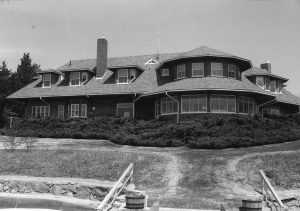
This installment features 151 Allen’s Point Road. The lovely Shingle-style home at 151 Allen’s Point was built in the early 1900s for the Boston physician A. E. Angier, who was listed at this address until about 1907.

Marion Republican Town Committee

The Marion Republican Town Committee will conduct its next monthly meeting on Monday, September 10at 7:00 pm at the Marion Music Hall, 164 Front Street, Marion. The guest speaker for this meeting will be Plymouth County District Attorney Timothy Cruz. The public and new members welcome.